

The first hit is harmless. A glowing ring closes on your watch. A notification congratulates you: “You hit your step goal, keep it up!”
It’s simple. Encouraging. Harmless. Until, somewhere between “just one more run” and “I’ll sleep when my score says I can,” the feedback loop tightens its grip. Welcome to the age of digital dopamine, where self-improvement and self-conditioning blur into one endless push for progress.
The Science of the Hit
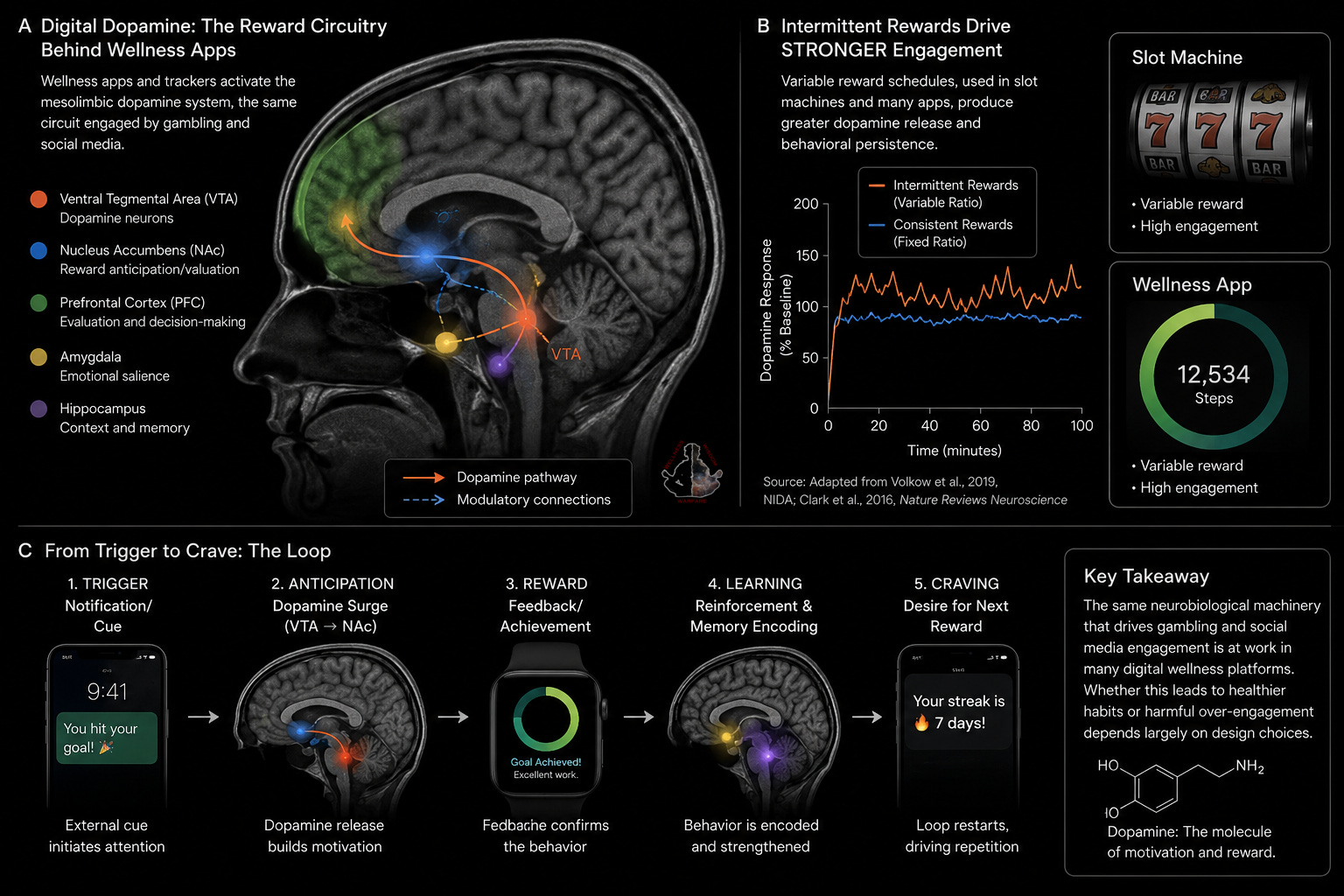
Dopamine, the neurotransmitter most associated with motivation and reward, did not evolve for smartphones. Its role in reinforcing survival behavior is well established in neuroscience going back to Wolfram Schultz’s landmark recordings of dopamine neurons in the 1990s. Schultz found that dopamine neurons do not fire most strongly when a reward arrives; they fire when an unpredicted cue signals that a reward is coming, and they barely respond at all when a reward arrives exactly as expected. When an anticipated reward fails to appear, dopamine activity actually dips below baseline (Schultz, 2016). In other words, dopamine encodes prediction and anticipation, not pleasure itself.
That single finding explains a great deal about wellness technology. A badge, a streak, a glowing ring closing, these are precisely the kind of unpredictable or almost-unpredictable cues that generate the strongest dopamine response, often stronger than the underlying accomplishment they represent. Wellness technology, for all its good intentions, runs on the same behavioral architecture as social media and, further back, casino slot machines: variable reinforcement, in which unpredictable rewards produce more persistent engagement than predictable ones.
The Illusion of Progress
Because dopamine tracks anticipation rather than achievement, checking a progress screen can produce a sharper hit than the underlying activity that earned it. Data starts to substitute for experience. Self-optimization becomes an identity, and the internal question quietly shifts from “how do I feel?” to “what does my app say I feel?”
This is not addiction in the clinical sense for most users. It is conditioning, and it is close to universal in gamified wellness products.
The Common Misunderstanding
The instinctive assumption, reinforced by a decade of tech criticism, is that gamifying anything erodes intrinsic motivation: give someone a badge for a behavior they used to do for its own sake, and they will start doing it only for the badge. Recent research in self-determination theory complicates this considerably. Studies on gamified fitness apps have found genuine “motivation crowding” effects in both directions: gamification can crowd out intrinsic motivation when it undermines a user’s sense of autonomy and competence, but it can also crowd in, reinforcing intrinsic motivation, when rewards are designed to support rather than override a user’s own sense of choice and mastery (motivation-crowding research on gamified fitness apps, 2023). The mechanism matters more than the mere presence of a reward. A badge that celebrates a personal best supports competence. A leaderboard that induces shame does not. Both are “gamification,” and treating them as the same design choice misses the actual variable that predicts harm.
When Tracking Becomes the Symptom
Where the evidence is more consistently concerning is compulsive self-monitoring itself, independent of whether the underlying gamification was well designed. A 2025-2026 study of 264 people, comparing 149 wearable users with 115 non-users, found that wearable users scored significantly higher on measures of obsessive-compulsive traits than non-users, and that roughly one in four wearable users reported negative psychological effects from calorie tracking, sleep tracking, or smart notifications, spanning anxiety, guilt, and a distorted sense of self driven by device data rather than lived experience (Wellness Watch or Worry Watch?, 2025).
Sleep tracking has produced its own named phenomenon: orthosomnia, an unhealthy preoccupation with achieving a “perfect” sleep score that itself interferes with sleep. A cross-sectional prevalence study found orthosomnia-like patterns are measurable in the general population of wearable users, not confined to a clinical fringe, and sleep researchers note that consumer sleep trackers are only moderately accurate against laboratory-grade equipment in the first place, making the scores themselves a shakier foundation for anxiety than users assume.
Reclaiming the Reward
None of this makes dopamine the enemy. It is the messenger that propels learning, curiosity, and the pursuit of goals worth pursuing. The problem is saturation, not stimulation, and the evidence increasingly suggests the harm is concentrated in specific design failures (reward structures that undermine autonomy, opaque scoring systems presented as objective truth) rather than gamification as an inherently corrupting force.
The healthiest form of reward still does not come from a number on a screen. It comes from presence: the slow run with no headphones, the breath taken without a timer, an activity pursued for its own sake rather than its metrics. If the last decade quantified the self, the harder and more useful work of the next one is learning which metrics deserve attention and which ones deserve to be ignored entirely.
W3 Insight
Digital wellness was built to help people improve, but the research on what actually helps is more specific than “gamification good” or “gamification bad.” The apps worth keeping are the ones that support a user’s own sense of competence and choice. The ones worth deleting are the ones that quietly replace how you feel with what the screen says you should feel.
W3 Evidence Index™
W3 Evidence Index™ Score: 7.0/10
Confidence Level: High Confidence
Full category breakdown, assessment, and limits available below for paid subscribers.
