

America’s national parks, from Yosemite’s granite cliffs to the Everglades’ wetlands, have spent the past decade running on a treadmill: visitation and responsibilities keep expanding while real purchasing power barely moves. Between FY2014 and FY2023, Congress’s discretionary appropriations for the National Park Service rose from $2.56 billion to $3.48 billion, a 36 percent increase in nominal dollars but only about 7 percent once adjusted for inflation (Congressional Research Service, 2024). Over that same period, 26 new park units joined the system and annual visitation climbed toward record highs.
That slow squeeze is the backdrop for two very different funding fights that played out within the past year: a proposed 37 percent cut to the NPS budget that Congress rejected in January 2026, and a follow-up proposal four months later that would cut the agency again, through a different account structure. Understanding both requires looking at the decade that preceded them, and at a harder question underneath the budget fights entirely: what are the parks actually worth, and does the federal government fund them anywhere close to that value?

Ten Years of Underfunding: Requests Versus Reality
Federal budgeting for public lands has never followed a straight line. Table 1 summarizes presidential budget requests against Congress’s enacted appropriations for the National Park Service from FY2014 through FY2023, based on Congressional Research Service reporting.
Table 1: NPS Discretionary Funding, Requested vs. Enacted (FY2014-FY2023)
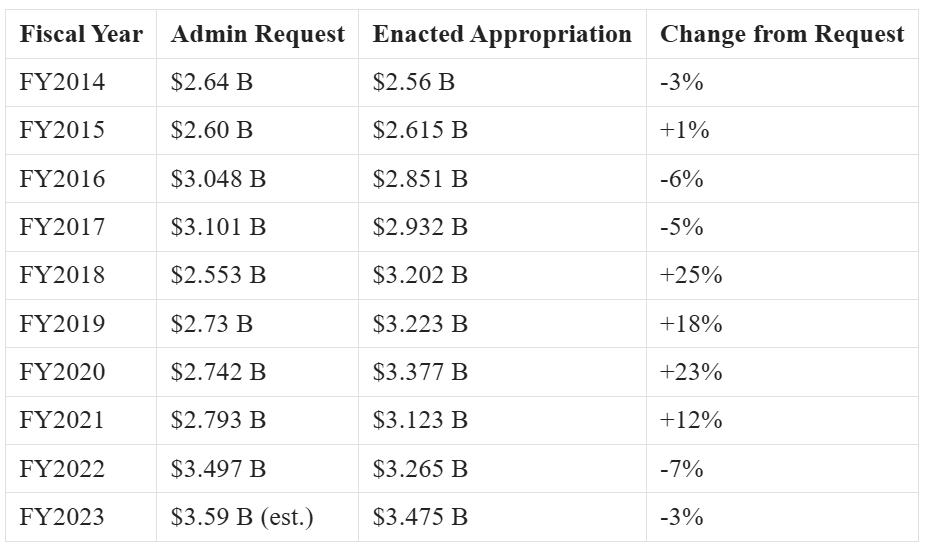
Source: Congressional Research Service NPS appropriations reports (Congressional Research Service, 2024, 2026).
Two patterns stand out. First, NPS discretionary budgets have struggled to outpace inflation even in years with nominal increases: the FY2023 appropriation, the highest enacted figure in the agency’s history at the time, represented only about a 7 percent real increase over FY2014 despite a decade of added parks, added visitors, and an aging infrastructure footprint. Second, the relationship between what a president requests and what Congress actually enacts has been inconsistent across both parties. In FY2018 and FY2019, Congress rejected proposed cuts from the incoming administration and appropriated well above the request. In FY2016 and FY2022, Congress appropriated somewhat below a requested increase. Neither party has a clean record of fully funding the requests it makes, and neither has a clean record of cutting the agency exactly as much as its own budget office proposed.
What Are the Parks Actually Worth?
Budget fights tend to argue over what NPS should receive without ever settling what the parks are actually worth, a harder and more interesting question that Harvard Kennedy School economist Linda Bilmes has spent years trying to answer directly. Bilmes, working with Colorado State University’s John Loomis and Michelle Haefele, built the first comprehensive economic valuation of the National Park System, published as the book Valuing U.S. National Parks and Programs: America’s Best Investment.
Their methodology centered on a peer-reviewed, nationally representative “willingness-to-pay” survey, asking Americans how much they would accept in additional annual taxes rather than lose 20 percent of park lands and programs. The results put the total economic value of the National Park Service at roughly $92 billion: about $62 billion tied to park lands, waters, and historic sites, and another $30 billion tied to NPS educational and cultural programs (Bilmes, Loomis, & Haefele, 2019). Layered on top of that willingness-to-pay figure, tourism tied to the parks generates an estimated $36 billion in economic activity and roughly 300,000 jobs in gateway communities, and the parks’ role as filming locations, from Death Valley standing in for Tatooine in the original Star Wars to Grand Teton in Brokeback Mountain, feeds into a film and television economy that captures value the agency itself never sees a meaningful share of.
Set against NPS’s actual discretionary budget of roughly $2.5 to $3.5 billion across the years Bilmes studied, her research puts the parks’ economic return at somewhere around 30 times what the federal government spends on them annually, an unusually large gap even by the standards of public infrastructure investment. “The national parks are the most beloved government entity in the country,” Bilmes said. “They have enormous approval ratings, 330 million visits a year... but the parks are on an unsustainable funding trajectory” (Harvard Gazette, 2019).
Bilmes’s diagnosis of why that gap persists is structural rather than purely political. NPS funding arrives through multiple restricted federal accounts, each with its own limits on how money can be used, and individual park units receive their own line-item budgets with tight caps on how much a director can shift between units to match funding to actual need, currently limited to about 20 percent of a unit’s appropriation. That structure works poorly for an agency with a permanent, multigenerational mission. Bilmes has proposed several concrete reforms: allowing NPS to retain interest earned on surplus visitor fees rather than returning it to the general treasury, raising the director’s fund-shifting flexibility from 20 percent toward 50 percent, and exploring longer, more flexible appropriation structures, including endowments and bond financing, that better match a multi-decade maintenance and conservation mission than annual line-item budgeting does.
The Maintenance Backlog and a Shrinking Workforce
Underfunding shows up most concretely in deferred maintenance, the accumulated cost of repair projects NPS has postponed for lack of funds. As of the end of FY2025, that backlog stood at an estimated $24.237 billion, up sharply from the roughly $12 billion Bilmes cited in her 2019 research and continuing to climb (Congressional Research Service, 2026; U.S. Department of the Interior, 2026). It includes unsafe bridges and roads, aging water and electrical systems, and deteriorating historic structures spread across more than 400 park units.
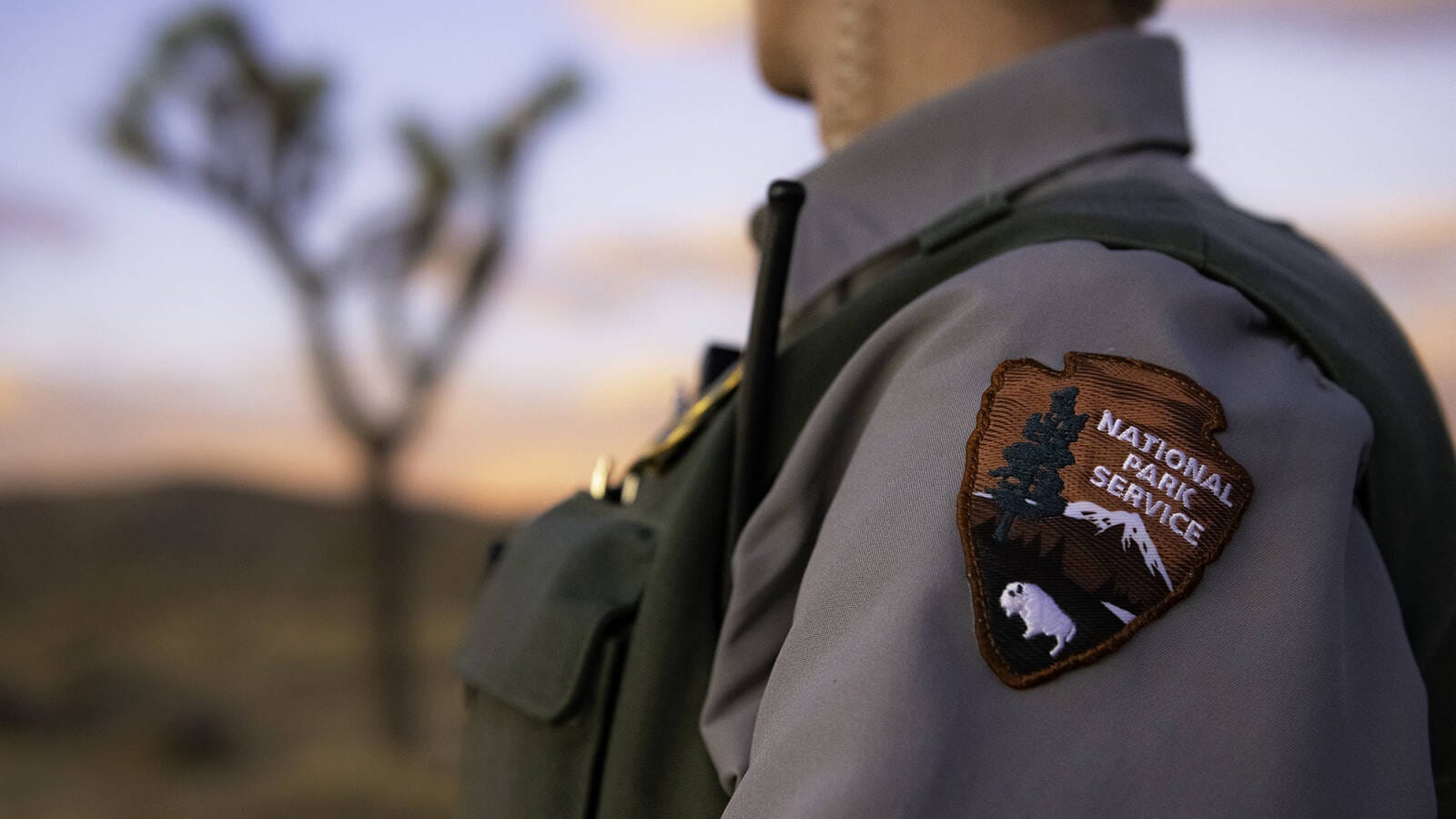
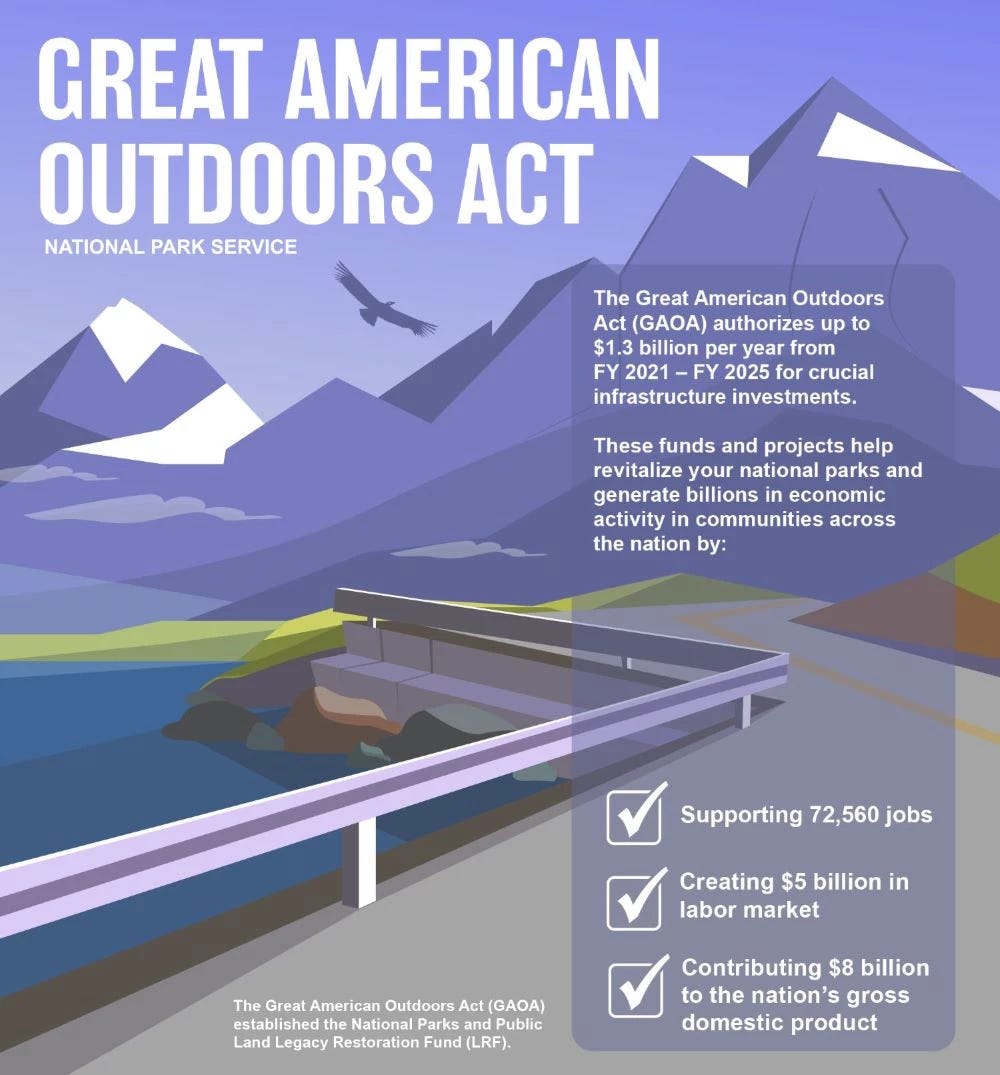
Congress attempted to address this in 2020 through the Great American Outdoors Act, which established a National Parks and Public Land Legacy Restoration Fund directing up to $1.3 billion per year to priority maintenance projects. NPS received the full amount for five consecutive years, meaningfully denting specific high-priority projects, but that fund expired in FY2025, and even at its peak it addressed only a fraction of the total backlog (Congressional Research Service, 2026).
Staffing has followed a similar trajectory. NPS reported roughly 19,894 full-time equivalent staff in FY2014 and 19,390 by FY2023, a modest decline on paper that understates the real strain, since visitation rose from around 281 million recreation visits in 2011 to over 327 million by 2019 over the same period that staffing fell (Congressional Research Service, 2024). The ratio of visits per employee climbed from roughly 13,400 to more than 18,000. Then, starting in January 2025, the picture changed more sharply: through a combination of pressured resignations, early retirements, and hiring freezes rather than formal layoffs, the Park Service lost close to 4,000 additional staff, nearly a quarter of its workforce, within about a year (Outside, 2026).
The FY2026 Fight, and How It Actually Ended
In its FY2026 budget request, the administration, through the Office of Management and Budget under Director Russell Vought, proposed $2.1165 billion in discretionary funding for NPS, a 37 percent cut from the $3.337 billion Congress had enacted for FY2025 (Congressional Research Service, 2026). Under that request, core park operations would have dropped by roughly $900 million, or 31 percent, and NPS’s own budget documents projected staffing would fall to about 13,598 full-time equivalent positions, a 26 percent reduction from FY2025 levels. Smaller accounts fared worse on paper: the Historic Preservation Fund was proposed for a 93 percent cut, National Recreation and Preservation for an 87 percent cut, and the Centennial Challenge matching-grant program for full elimination.
Congress did not adopt that request. Both the House and Senate Interior-Environment appropriations bills rejected the steepest reductions over the summer of 2025, and the final result, signed into law as P.L. 119-74 on January 23, 2026, provided $3.267 billion for NPS, about 2 percent below the FY2025 enacted level but 54 percent above what the administration had requested (Congressional Research Service, 2026). Core park operations funding was held essentially flat. This is worth stating plainly, since a version of this story that stops at the 37 percent request without noting the resolution would leave readers with an inaccurate picture of where things landed: the most severe proposed cuts to the FY2026 NPS budget did not happen.
What Did Happen: Workforce Attrition and a Shutdown Standoff
The FY2026 appropriations fight was not the only pressure the Park Service faced during this period. Separately, ahead of the federal government shutdown that began October 1, 2025, OMB directed agencies to consider reduction-in-force notices for employees whose programs lost funding during the lapse and were not consistent with the administration’s priorities, an unusual use of a shutdown that several former officials and legal analysts described as a break from historical practice (Lawfare, 2025). Roughly 4,200 employees across at least seven federal agencies received RIF notices starting October 10, before a federal judge paused the layoffs pending litigation (NPR, 2025). That confirmed figure is dramatically smaller than some contemporaneous advocacy accounts suggested at the time, a reminder that even a genuinely alarming policy development is better served by the verified count than by an inflated one.
The more consequential attrition at NPS specifically came not from formal RIFs but from the slower churn of resignations, retirements, and frozen hiring that had already reduced the agency’s workforce by nearly 4,000 positions since January 2025 (Outside, 2026).
The FY2027 Proposal: A Different Route to a Similar Destination
Four months after Congress finalized FY2026 funding, the administration’s FY2027 budget request, released in early April 2026, proposed cutting NPS again. This time the request sought a $736 million reduction to park operations, more than 25 percent, on top of the workforce already lost, and proposed eliminating roughly 3,000 additional ranger and staff positions (Outside, 2026; National Parks Conservation Association, 2026). The construction and major maintenance account was proposed for a 72 percent cut, down to less than $50 million, at a moment when the deferred maintenance backlog sits above $24 billion.
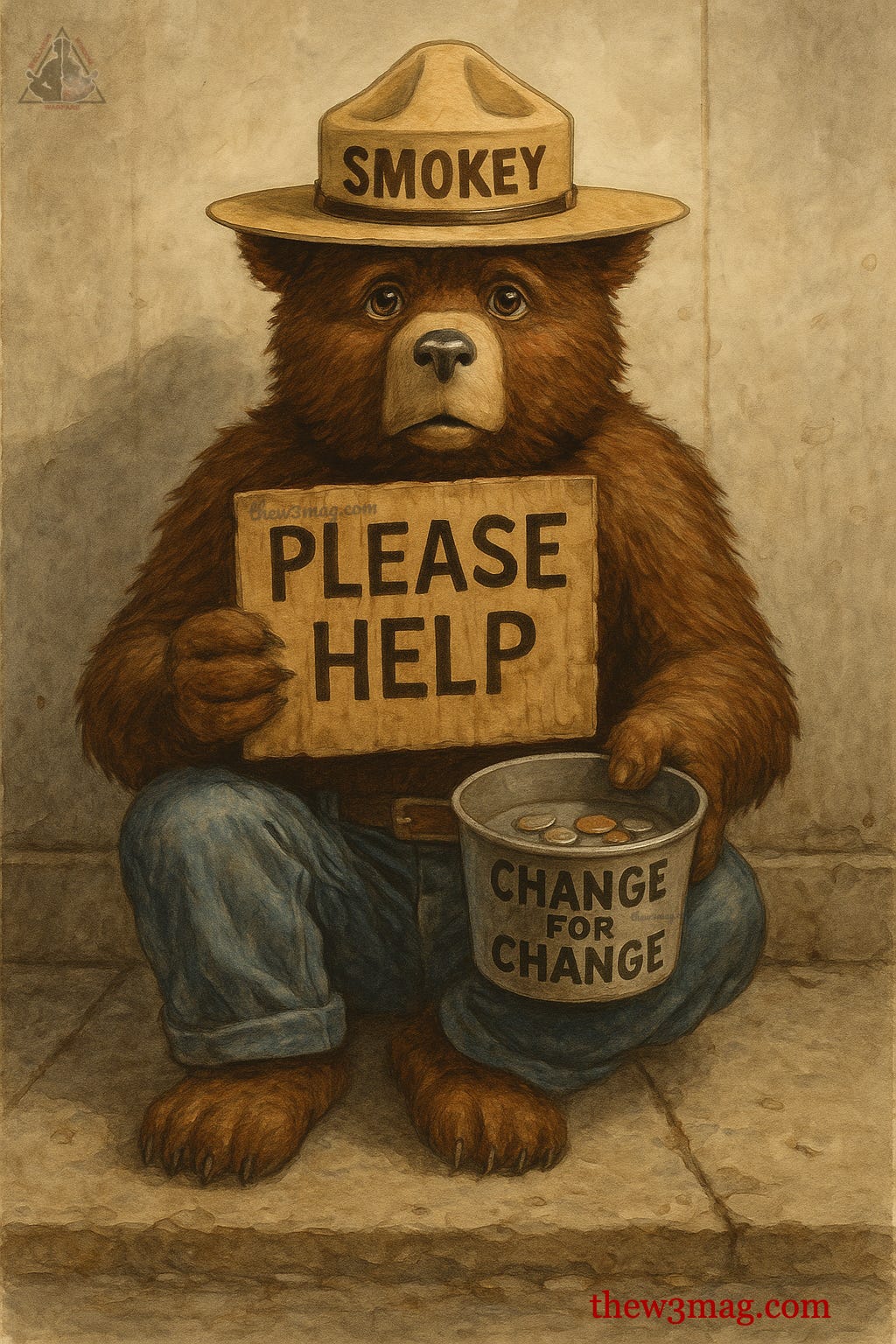
Congress alone holds the power of the purse, and as the FY2026 outcome demonstrated, a budget request is a starting position, not a final outcome. Multiple members of the Senate Appropriations Committee publicly criticized the FY2027 proposal within weeks of its release (Merkley, 2026). Whether the FY2027 request meets the same fate as its FY2026 predecessor, full rejection, partial rejection, or something closer to adoption, was not yet resolved as of this writing.
What This Pattern Actually Shows
Read across a decade, the National Park Service’s funding story is less a single crisis than a recurring negotiation between an executive branch that has, under multiple administrations of both parties, periodically proposed deep cuts or flat funding, and a Congress that has just as often restored funding closer to historical levels, sometimes above what was requested. That negotiation has real costs regardless of how any single year resolves: a maintenance backlog that keeps growing even in years when funding rises, a workforce that has shrunk relative to visitation for over a decade, and gateway communities whose local economies are tied to park operations they do not control.
Bilmes’s valuation research adds a dimension the annual appropriations fight rarely surfaces: even taking the most favorable enacted budget of the past decade, the National Park Service still receives a small fraction of the economic value independent research suggests it generates for the country. The FY2026 outcome is genuine evidence that Congress, across party lines, has been unwilling to accept the most severe proposed cuts to this particular agency. It is equally genuine evidence that the underlying structural gap, both the funding-versus-value gap Bilmes has documented and an aging infrastructure footprint funded at levels that rarely account for real inflation or expanding responsibilities, remains unresolved regardless of which budget request wins in any given year. Readers who care about the parks system have reason for both relief and continued attention: the immediate threat was turned back, a new one arrived within months, and the deeper financing structure Bilmes has spent years trying to reform has not fundamentally changed either way.

W3 Evidence Index™
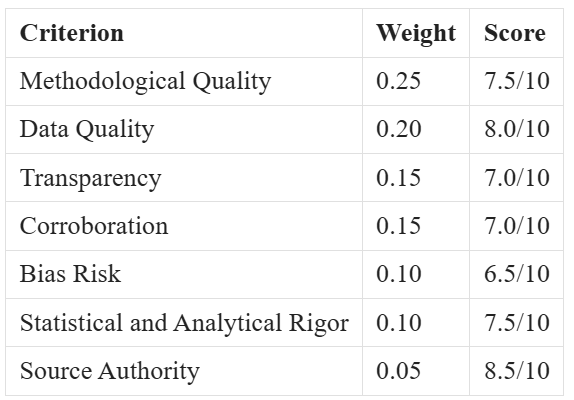
W3 Evidence Index™ Score: 7.4/10
Confidence Level: High Confidence
W3 Evidence Index™: Full Breakdown
W3 Evidence Index™ Score: 7.4/10
Confidence Level: High Confidence
Assessment: The historical budget data underlying this piece is unusually strong for a magazine feature, drawn directly from Congressional Research Service reports, which are nonpartisan and rigorously sourced. The Bilmes valuation research adds a second, independently strong evidentiary layer: a peer-reviewed, nationally representative willingness-to-pay survey methodology published as an academic book, which is a considerably more rigorous approach to economic valuation than the informal “worth billions” claims common in this kind of coverage. The original source material used a rounded “$100 billion” figure from a 2019 news write-up; this version uses the more precise $92 billion total from the underlying Harvard Kennedy School research summary.
Limits: Bilmes’s valuation figures date to 2019 and have not been widely updated since; the $92 billion estimate should be read as a rigorous historical benchmark rather than a current, inflation-adjusted figure. The FY2027 budget request’s ultimate fate in Congress remains unresolved as of this writing, and any assessment of its likely outcome is informed speculation based on the FY2026 precedent, not a settled fact.
Bottom Line: Readers should place high confidence in both the historical funding figures and the Bilmes valuation research described here, each grounded in nonpartisan government reporting or peer-reviewed academic methodology respectively. Readers should treat the specific dollar comparison between current spending and 2019 valuation figures as directionally meaningful rather than precisely current, since neither figure has been recalculated on the same timeline.
References
Bilmes, L. J., Loomis, J. B., & Haefele, M. (2019). Valuing U.S. National Parks and Programs: America’s Best Investment. Routledge.
Congressional Research Service. (2024). National Park Service (NPS) appropriations: Ten-year trends. Library of Congress. https://www.congress.gov/crs-product/R42757
Congressional Research Service. (2026). National Park Service: FY2026 appropriations. Library of Congress. https://www.congress.gov/crs-product/IF13116
Harvard Gazette. (2019, September 23). National parks’ economic benefits put at over $100B annually.
Lawfare. (2025). Reductions in force during shutdowns. https://www.lawfaremedia.org/article/reductions-in-force-during-shutdowns
Merkley, J. (2026). Interior Appropriations Subcommittee Ranking Member Merkley: Cuts in Trump’s budget request to leave lasting scars on public lands, tribes, and human health [Press statement]. U.S. Senate.
National Parks Conservation Association. (2026). Inside the FY26 National Park Service budget. https://www.npca.org/articles/11293-inside-the-fy26-national-park-service-budget
NPR. (2025, October 10). Trump administration says about 4,200 federal employees face layoffs. https://www.npr.org/2025/10/10/nx-s1-5570933/shutdown-federal-workers-rifs-layoffs-vought
Outside. (2026). Trump’s 2027 budget proposals would cut NPS staff, slash budgets.
U.S. Department of the Interior. (2026). Deferred maintenance and repair. https://www.doi.gov/deferred-maintenance-and-repair