

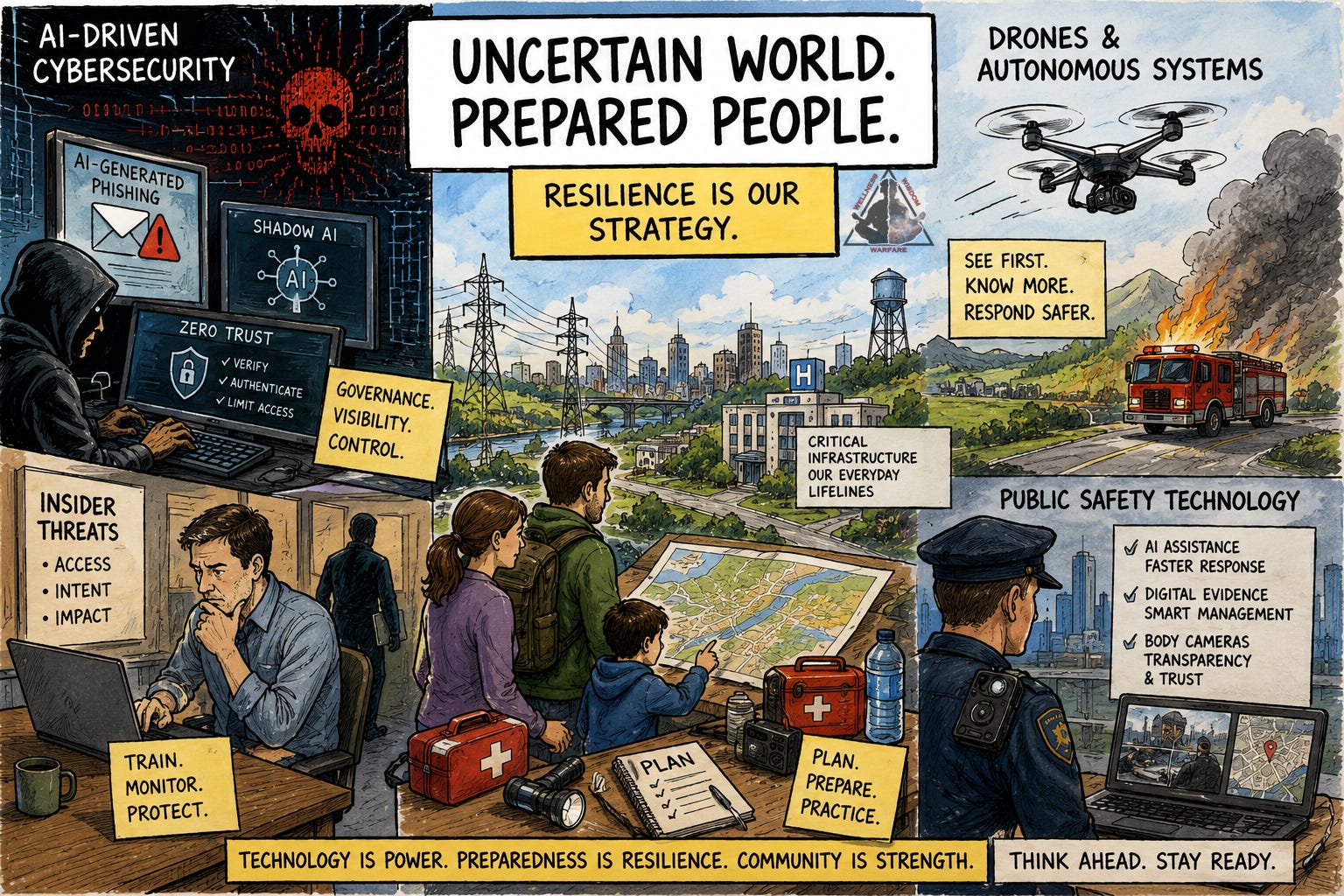
In a world that feels increasingly uncertain, preparedness is not optional. It is essential. W3 Magazine’s Warfare category is not about conflict for conflict’s sake. It is about the mindset and systems required to protect ourselves, our businesses, and our communities. From cybersecurity and critical infrastructure to drones and emergency planning, this article covers the major trends shaping modern security, physical and digital, along with practical strategies for resilience.
AI-Driven Cybersecurity: The New Battleground
The frontline of modern security is increasingly digital. Cyberattacks have escalated in both frequency and sophistication, and artificial intelligence is amplifying offense and defense at the same time. AI-powered malware can adapt more quickly than earlier generations of threats, and attackers now use generative AI to write phishing messages that mimic a target’s writing style or to automate reconnaissance across networks.
The clearest sign of how much the threat landscape has shifted came from ISACA’s 2026 Tech Trends and Priorities report, which surveyed roughly 3,000 IT and cybersecurity professionals and found that AI-driven social engineering has overtaken ransomware as the top concern among security leaders, cited by 63 percent of respondents compared with 54 percent for ransomware and extortion (ISACA, 2026). That does not mean ransomware has become less costly; global ransomware damage is projected to rise roughly 30 percent between 2025 and 2026. It means AI has changed what worries security leaders most, not simply added a new item to an old list.
A related and even more concrete problem is shadow AI: employees using AI tools their organization has not approved, sanctioned, or secured. IBM’s 2025 Cost of a Data Breach Report found that breaches involving shadow AI cost organizations an average of $670,000 more than other incidents, and that 97 percent of breached organizations lacked proper AI access controls at the time of the incident (IBM, 2025). Separate industry survey data suggests that a majority of organizations either have no AI governance policy or are still developing one. To mitigate this, companies need AI governance frameworks with real teeth: approval processes for new AI tools, access controls on sensitive models, and regular audits, not just a policy document that sits unused.
Zero-trust and quantum-resistant security represent the next layer of this shift. Zero-trust architectures assume no device or user is trustworthy by default, requiring authentication and authorization for each request, which limits how far an attacker can move after breaching a single device. Quantum computing’s eventual threat to traditional encryption means organizations serious about long-term data security are beginning to adopt quantum-resistant algorithms now, ahead of the point where it becomes urgent rather than precautionary.
Shadow AI, Insider Threats, and Governance Gaps
The rapid, largely unsupervised adoption of AI tools has created a governance gap similar to the one “shadow IT” created a decade ago: employees using unapproved software to move faster, often without realizing what data they are exposing in the process. Closing that gap requires clear policies on AI use, real employee education about data handling, and approved tools that actually meet the needs employees were trying to solve by going around IT in the first place.
Insider threats extend beyond well-meaning employees using the wrong tool. Malicious insiders can exploit legitimate access to steal intellectual property, sabotage systems, or assist competitors. Role-based access controls, activity monitoring, and regular audits help surface suspicious behavior before it becomes a full breach, and training employees to recognize social engineering tactics, spear-phishing and pretexting in particular, remains one of the highest-value, lowest-cost defenses available.
Public Safety Technology: AI, Digital Evidence, and Body-Worn Cameras
While cybersecurity protects data and networks, public safety technology protects people directly. AI is increasingly used in emergency call centers and law enforcement operations; vendor research from Versaterm on public safety technology trends describes conversational AI systems that can triage 911 calls, assess urgency, and help dispatch appropriate resources faster by analyzing caller tone, language, and context (Versaterm, 2024). As with any vendor-produced research, these figures should be read as directional industry reporting rather than independently audited findings. AI also increasingly assists officers with report writing, freeing time for patrol and community engagement.
Digital evidence management is a related, less visible challenge. Police departments now handle enormous volumes of footage from body cameras, dash cams, drones, and civilian phones. Modern evidence management systems organize and secure this data while maintaining chain of custody so it remains admissible in court, and AI-assisted search can identify relevant footage faster by cross-referencing timestamps, locations, and object recognition.
Body-worn cameras have become standard in law enforcement, both to build community trust by documenting interactions transparently and to protect officers from false accusations. As the technology matures, departments need clear policies on activation, storage, and privacy, and some now pair cameras with analytics that flag use-of-force events or track officer well-being over time.
Drones and Autonomous Systems
Drones have moved well past novelty status into essential public safety and security infrastructure. The “Drone as First Responder” model, in which drones deploy automatically to incident scenes ahead of ground units, gives responders real-time video and situational awareness, particularly valuable for reaching remote areas quickly, monitoring hazardous environments like chemical spills, and searching for missing persons. Law enforcement increasingly uses drones for tactical awareness in high-risk situations, and industrial operators use them to inspect infrastructure, monitor pipelines, and detect leaks.
Beyond public safety agencies, drones increasingly support individual and business preparedness: farmers surveying crops, homeowners checking property perimeters, and security firms conducting patrols. Operators must follow FAA rules and respect privacy law, and the technology continues to move toward AI-enabled drones capable of more autonomous decision-making and coordinated, multi-drone operations.
Physical Security, Situational Awareness, and Emergency Preparedness
Preparedness extends beyond cyber and digital domains. Physical security for homes, offices, and public spaces continues to evolve alongside new threats: smart locks, biometric access control, and integrated alarm systems provide layered defense against intrusion. Cybersecurity and physical security increasingly converge through the Internet of Things, since networked cameras, thermostats, and smart lighting can all become attack vectors if left unsecured. Regular firmware updates, strong passwords, and network segmentation meaningfully reduce that exposure.
Situational awareness matters in any high-risk environment. Military training’s OODA loop, observe, orient, decide, act, offers a simple model civilians can adopt to improve reaction time in an emergency: scanning surroundings, identifying exits, reading body language, and trusting well-calibrated intuition. Self-defense training builds real confidence and competence, but it works best paired with legal knowledge and de-escalation skills rather than treated as a standalone solution.
Emergency preparedness closes the loop. Natural disasters, infrastructure failures, and civil disruptions can all interrupt supply chains, power, and communication with little warning. Households and businesses benefit from maintaining basic emergency kits, food, water, first aid, and backup power, along with concrete shelter-in-place and evacuation plans. Organizations that run regular drills, keep contact lists current, and coordinate ahead of time with local emergency services consistently respond better when something actually happens than those relying on improvisation.
Embrace Preparedness, Not Panic
Modern security, whether digital or physical, is genuinely complex, but preparedness does not require living in fear. It means taking proactive, specific steps to reduce risk. Understanding the current threat landscape, implementing real AI governance rather than policy in name only, and adopting zero-trust principles all give organizations and individuals a meaningful edge. Public safety technology, from AI-assisted dispatch to better evidence management, strengthens both community security and accountability at the same time. Drones and autonomous systems expand real-time situational awareness. Physical security, situational awareness, and basic emergency preparedness round out a posture built for the world as it actually is, not the one from five years ago.
For W3 readers, preparedness offers something more durable than fear: a sense of control. Investing in real cybersecurity governance, training people rather than just buying tools, and maintaining basic emergency readiness all compound over time, and as the threat landscape keeps shifting, continued learning remains the most reliable defense available.
W3 Evidence Index™
W3 Evidence Index™ Score: 6.6/10
Confidence Level: High Confidence
Full category breakdown, assessment, and limits available below for paid subscribers.
