
The Tyranny of Certainty
Why modern people are so uncomfortable saying "I don't know"

There was a time when uncertainty was considered a form of wisdom. Today, it is often treated like weakness.
Modern society rewards confidence with almost religious intensity. We are encouraged to react immediately, form opinions quickly, and defend those opinions publicly with unwavering conviction. Politicians speak in absolutes. Social media rewards emotional certainty over thoughtful hesitation. News cycles move so rapidly that people are expected to develop fully formed conclusions about world events before all the facts have even emerged.
Somewhere along the way, saying “I don’t know” became socially uncomfortable. And yet, those three words may be among the most intellectually honest a person can say.
The irony is difficult to ignore. Humanity now has more access to information than at any other point in history, yet modern discourse often feels less reflective and more reactionary. People consume an endless stream of headlines, clips, and commentary, but very little time is spent sitting with uncertainty itself. We have confused being informed with being wise.
This Isn’t New
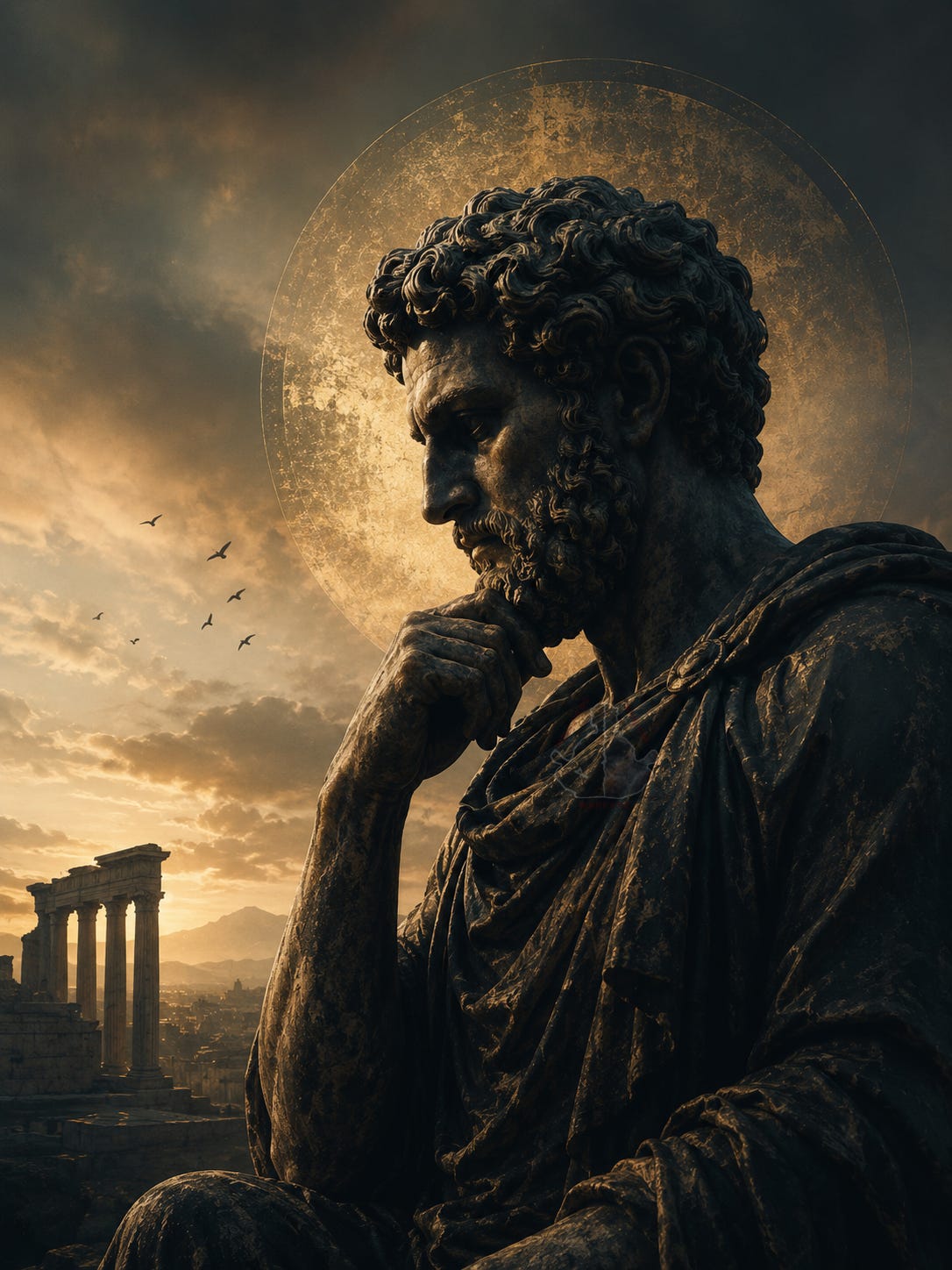
The ancient Greeks warned about this long before smartphones or cable news. Socrates built much of his philosophy around the recognition that people often overestimate what they truly understand, an insight preserved for us mainly through Plato’s dialogues rather than Socrates’s own writing, since he left none. His famous association with the idea that wisdom begins in recognizing one’s own ignorance was not an expression of weakness. It was a warning against intellectual arrogance. Aristotle, in a related vein, emphasized disciplined reasoning, observation, and measured judgment over impulsive reaction.
Centuries later, the Stoics refined that idea further. Marcus Aurelius repeatedly reminded himself that perception is not always reality and that emotional reactions can distort judgment, and the Stoics broadly believed peace of mind came not from controlling the external world, but from learning to think clearly within it.
Many Eastern philosophical traditions arrived at strikingly similar conclusions through entirely different cultural paths. Buddhism teaches that attachment, including attachment to rigid beliefs and identities, is often the root of suffering. Taoism approaches reality as fluid and dynamic, resisting the tendency to force the world into fixed categories and simple binaries.
Modern society, by contrast, often moves in the opposite direction. We seek certainty not because reality has become more certain, but because uncertainty feels psychologically uncomfortable, and that discomfort has a real evolutionary logic behind it.
The Biology Behind the Discomfort
The human brain evolved for survival, not perfect objectivity. In dangerous ancestral environments, rapid conclusions were often adaptive even when they were wrong: assuming a rustling bush concealed a predator was safer than carefully weighing probabilities, since the cost of a false alarm was minor compared to the cost of a missed threat. This is not just a folk explanation. Evolutionary psychologists Martie Haselton and David Buss formalized this pattern as error management theory, showing that when the cost of two types of mistakes is asymmetric, natural selection favors decision-making systematically biased toward the cheaper error, in this case, over-detecting danger rather than under-detecting it (Haselton & Buss, 2000).
That instinct still operates today, but the environment triggering it has changed completely. Instead of occasional uncertainty, modern people face a nonstop stream of global crises, political conflict, economic instability, technological disruption, and social fragmentation, while digital platforms simultaneously pressure everyone to form immediate opinions about all of it. The result is a kind of cognitive overload, and when people become overwhelmed, they often seek psychological relief through certainty, even when that certainty is false. False certainty can still feel emotionally stabilizing, which is precisely what makes it so appealing under pressure.
When Opinions Become Identities
This helps explain why modern discourse has become so emotionally charged. Many people are no longer engaging with ideas as ideas. They are engaging with them as identities. Opinions become tied to belonging, morality, and social acceptance, and once that happens, disagreement stops feeling like an intellectual exchange. It feels personal. People are not merely debating facts anymore. They are defending psychological territory, which is part of what makes contemporary public discourse so exhausting to participate in.
Social media intensifies this dynamic because certainty performs better than nuance in an engagement-driven system. A confident statement spreads faster than a cautious one. Outrage generates more engagement (likes, comments, shares, etc.,) than reflection. The platform incentive structure quietly rewards oversimplification while punishing ambiguity, regardless of which one better describes reality.
The Case for Intellectual Humility
Reality itself remains stubbornly complex. Most major societal problems involve incomplete information, competing incentives, historical context, unintended consequences, and variables no single person can fully observe. Serious issues rarely fit neatly into the ideological categories modern discourse keeps trying to force them into.
This is where intellectual humility earns its keep. It does not mean refusing to form opinions, moral relativism, or passive indecision. It means recognizing that every individual perspective is inherently limited, and holding conclusions with enough confidence to act while staying genuinely open to revising them when new information arrives. That balance is becoming rarer, in part because many people now feel pressured to maintain instant expertise on every issue, conflict, and cultural debate happening simultaneously across the planet. Human attention and judgment were never built to carry that volume of real-time interpretation, and a meaningful share of modern anxiety likely comes not from events themselves, but from the felt obligation to immediately process all of them at once.
Conclusion
Saying “I don’t know” creates space between observation and judgment. It interrupts the compulsive pull toward immediate certainty, keeps the mind curious rather than defensive, and lowers the emotional temperature of a disagreement by removing the illusion that every issue must resolve instantly into absolute categories of right and wrong. In many ways, the refusal to admit uncertainty is what keeps public discourse trapped in a loop of perpetual outrage: people fear that acknowledging complexity will weaken their position, when in practice it usually strengthens their actual understanding of it.
Wisdom has never required omniscience. It has always required perspective. Perhaps the more useful cultural shift available right now is not more information, but a healthier relationship with the limits of what any one person can actually know. The modern world encourages speed. Philosophy encourages pause. Not certainty, not ideological performance, not constant outrage. Just enough stillness to think clearly again.
W3 Evidence Index™
W3 Evidence Index™ Score: 6.0/10
Confidence Level: Moderate Confidence
This is a philosophical and cultural argument rather than an empirical study. Its historical and philosophical characterizations (Socrates, Aristotle, Stoicism, Buddhism, Taoism) are accurate general descriptions of well-documented traditions, and its central psychological claim about threat-detection bias is grounded in a real, peer-reviewed evolutionary psychology framework (Haselton & Buss, 2000). Readers should treat the piece’s broader argument about modern discourse as reasoned interpretation rather than as a claim resting on quantitative evidence.