

Most people do not make their worst decisions because they lack information.
They make them because the present feels louder than everything else.
The argument feels urgent. The insult feels intolerable. The trend feels permanent. The crowd feels convincing. The fear feels rational because everyone else is afraid. The victory feels final because no consequence has arrived yet. In the middle of the moment, emotion often borrows the costume of truth.
Then time passes.
The confident prediction becomes embarrassing. The fashionable certainty becomes a footnote. The moral compromise becomes harder to explain. The crowd moves on, leaving individuals with the consequences of the things they defended, ignored, repeated, or excused. What felt obvious at the time becomes strange later. What felt courageous becomes performative. What felt harmless becomes a pattern.
This is why the phrase matters: Think like time is watching.
Not because every choice is monumental. Not because life should be lived under theatrical seriousness. Most decisions are ordinary. Most reactions disappear. Most conversations do not become history.
But patterns do.
The way we think, decide, react, rationalize, and repeat ourselves becomes visible over time. Individual habits become character. Shared assumptions become culture. Public moods become institutions. Unexamined fears become policies, loyalties, exclusions, and myths. Time does not merely pass over human life. It audits it.
The central argument of this essay is simple: wisdom is the discipline of thinking beyond the immediate emotional climate of the present.
History, philosophy, and cultural memory do not hand us clean answers, but they sharpen our questions before life, society, or consequence forces harder lessons.
That is not nostalgia. It is not quote collecting. It is not pretending earlier ages were wiser than ours. The past was often brutal, foolish, vain, violent, superstitious, and unjust. Ancient people were not morally superior because they lived before smartphones. They were human, which means they were familiar.
They feared loss. They chased status. They excused power. They confused confidence with truth. They mistook temporary victories for permanent meaning. They built magnificent systems of thought and also terrible systems of cruelty. That is precisely why the past matters. It does not flatter us. It implicates us.
To think like time is watching is to ask: How will this reasoning look when the emotion fades? What pattern am I participating in? What am I refusing to see because it would cost me comfort, status, belonging, or certainty? What will this decision teach me later if I am too proud to learn from it now?
Those questions are not soft. They are demanding. They are the beginning of wisdom.
The Moment Is a Poor Judge of Itself
Human beings repeatedly mistake intensity for permanence.
A public panic feels like a new reality. A social fashion feels like moral progress. A backlash feels like justice. A personal wound feels like destiny. The present has a talent for exaggerating itself. It presents its pressures as final. It says: decide now, react now, condemn now, belong now, believe now.
Wisdom begins by distrusting that voice.
This distrust is not cynicism. It is judgment. Aristotle’s concept of practical wisdom, often translated as phronesis, was not abstract cleverness. It was the cultivated capacity to deliberate well about what is good and fitting in concrete situations (Aristotle, 1999). Practical wisdom requires more than intelligence. It requires moral perception, experience, self command, and an ability to recognize what kind of situation one is actually in.
That last part is harder than it sounds.
Most people do not fail only because they choose the wrong answer. They fail because they misread the moment. They mistake provocation for emergency, applause for integrity, popularity for evidence, repetition for truth, and outrage for moral seriousness. They think they are deciding from principle when they are often deciding from fear, vanity, fatigue, resentment, or tribal belonging.
Modern psychology supports what ancient moral philosophy often observed in different language. Ziva Kunda’s influential work on motivated reasoning argued that people often draw conclusions through biased cognitive processes that favor preferred outcomes, especially when identity, desire, or self protection are involved (Kunda, 1990). Jonathan Haidt’s social intuitionist model similarly challenged the flattering idea that moral judgment usually begins with calm reasoning. Much moral judgment, he argued, begins with quick intuitive evaluation, while reasoning often arrives later to defend what intuition already decided (Haidt, 2001).
That does not mean reason is useless. It means reason is vulnerable.
Hugo Mercier and Dan Sperber argue that human reason evolved largely in social contexts, where people produce justifications, evaluate arguments, and navigate cooperation (Mercier & Sperber, 2017). This makes reason powerful, but also socially exposed. We are not detached machines processing neutral evidence. We are meaning making creatures, sensitive to reputation, group membership, shame, loyalty, and status.
The present exploits this vulnerability.
When an idea is socially rewarded, we often experience agreement as insight. When dissent is socially punished, we may experience silence as prudence. When a crowd agrees with us, our confidence rises faster than our understanding. When a claim helps us feel righteous, injured, superior, or safe, we become less interested in testing it.
Time is the counterpressure.
It strips away the heat of the room. It separates durable reasoning from emotional theater. It reveals whether a belief can survive outside the moment that made it convenient.

History Does Not Repeat Like a Machine
The cliché says history repeats itself.
The truth is more difficult and more useful. History does not repeat like a machine. It recurs like a pattern under altered conditions.
Human beings encounter new technologies, new institutions, new languages, and new crises, but many of the underlying pressures remain recognizable. Fear still seeks certainty. Power still seeks justification. Crowds still seek belonging. Pride still resists correction. Ambition still hides behind noble language. Moral cowardice still calls itself realism. Vanity still dresses itself as conviction.
This is why historical thinking matters.
David Lowenthal argued that the past is both essential and inescapable, but also constantly reshaped by present needs (Lowenthal, 2015). We do not approach history as blank observers. We inherit, select, contest, domesticate, and sometimes weaponize it. We use the past to explain who we are, but also to avoid what we do not want to face.
That is where wisdom must be careful.
The past is not a warehouse of easy lessons. It is not a motivational poster. It is not a costume closet for modern arguments. Serious historical consciousness requires humility before evidence, context, distance, and complexity. It asks us to resist two opposite errors: treating the past as automatically superior, and treating it as automatically obsolete.
Nietzsche understood the danger of both. In “On the Uses and Disadvantages of History for Life,” he criticized historical knowledge that becomes sterile accumulation, detached from vitality and judgment (Nietzsche, 1997). For Nietzsche, history mattered when it served life, not when it buried life under inert learning. This does not license careless interpretation. It reminds us that historical knowledge should deepen perception, not merely decorate opinion.
Jan Assmann’s work on cultural memory helps clarify why societies preserve some pasts and forget others. Cultural memory is not simply private recollection enlarged to the scale of a group. It is sustained through texts, rituals, monuments, institutions, symbols, and repeated acts of transmission (Assmann & Czaplicka, 1995). Aleida Assmann further emphasizes that cultural memory depends on media, archives, places, and practices that help societies organize continuity across generations (Assmann, 2011).
This matters because memory is never neutral.
What a culture remembers shapes what it notices. What it forgets shapes what it repeats. What it commemorates shapes what it admires. What it refuses to name becomes part of its moral atmosphere.
Paul Ricoeur’s work on memory, history, and forgetting is useful here because it treats memory not as a simple archive but as a moral and interpretive problem (Ricoeur, 2004). Societies can remember too little. They can also remember selectively, sentimentally, or vindictively. Forgetting can sometimes be ordinary and necessary, but it can also become evasion. Memory can preserve truth, but it can also preserve grievance, myth, and self deception.
The task is not simply to remember. The task is to remember truthfully enough to become less foolish.
What Wisdom Is Not
Wisdom is one of the most abused words in modern culture.
It is often reduced to a visual style: old books, marble statues, Latin phrases, candlelight, desert monks, Stoic quotes over storm clouds. It is treated as a mood, an aesthetic, or a form of intellectual branding. A person can now perform “depth” through quotation without ever becoming more honest, more patient, more courageous, or more disciplined.
That is not wisdom. That is costume.
Wisdom is not nostalgia. Nostalgia is often memory with the burden removed. It selects warmth, simplifies conflict, polishes difficulty, and turns the past into a shelter from the present. Nostalgia can be emotionally meaningful, but it becomes dangerous when it pretends to be analysis.
Wisdom is not antiquarianism. Knowing old things does not automatically make a person wise. One can study empire and still crave domination. One can quote Marcus Aurelius while behaving like a minor tyrant at home. One can admire Socrates and still refuse the inconvenience of a serious question.
Wisdom is not cynicism. The cynic often sees corruption but loses the ability to see duty. Cynicism can feel intelligent because it is rarely surprised, but not being surprised is not the same as understanding. It may protect the ego from disappointment, but it also protects the conscience from responsibility.
Wisdom is not certainty. Certainty may sometimes be earned, but it is often borrowed from emotion. When reflection is weakest, certainty can become strongest because the mind wants relief. It is tiring to hold complexity. It is socially costly to say “I do not know.” It is uncomfortable to admit that one’s preferred side, belief, institution, tradition, or identity contains contradiction.
Wisdom is the harder discipline: recognizing patterns, asking better questions, and resisting the pressure to mistake immediacy for clarity.
It is not passive. It does not mean endlessly delaying judgment. Some situations require decision. Some moral lines must be drawn. Some harms must be named. But wise judgment understands that speed is not the same as clarity, and intensity is not the same as truth.
The wise person is not the one who never acts.
The wise person is the one who has trained the mind not to be ruled by the first emotion that arrives wearing a crown.
The Stoic Test of Perspective
Stoicism is now so frequently packaged for productivity culture that it can be difficult to hear its original seriousness.
The Stoics were not selling calm as a lifestyle accessory. They were developing disciplines of perception, judgment, desire, and action under conditions of uncertainty, power, loss, and mortality. Marcus Aurelius wrote as an emperor, but his private notes repeatedly return to the fragility of reputation, the brevity of life, the discipline of attention, and the need to see events without being enslaved by appearances (Marcus Aurelius, 2002). Seneca, writing under the pressures of imperial Rome, warned against being carried away by fear, ambition, anger, luxury, and public opinion (Seneca, 1969).
The useful Stoic lesson is not “do not feel.”
It is “do not surrender judgment to every feeling.”
That distinction matters. Emotional life is not the enemy of wisdom. Grief, anger, fear, love, shame, and hope all carry information. But they do not always carry proportion. The Stoic discipline of perspective asks the mind to widen its frame. What is actually in my control? What am I adding to this event through interpretation? Will this matter in the way I think it matters? What does duty require, rather than ego?
To think like time is watching is deeply compatible with this discipline. Time widens the frame when emotion narrows it. It asks us to imagine the future witness. Not the imaginary audience of social approval, but the quieter witness of consequence.
How will I understand this reaction when I am no longer angry?
How will this decision look when I am explaining it to someone who trusted me?
How will this belief age when the trend that rewarded it disappears?
How will my silence sound when the cost of speaking has passed?
These are not abstract exercises. They are moral rehearsals.
Arendt and the Problem of Thoughtlessness
Hannah Arendt’s work remains valuable because she took thinking seriously as a moral activity without reducing morality to private sentiment.
In The Human Condition, Arendt distinguished between different forms of human activity and reflected on action, plurality, speech, and public life (Arendt, 1998). In Eichmann in Jerusalem, her controversial account of Adolf Eichmann’s trial, she developed the phrase “the banality of evil,” not to excuse evil, but to examine how catastrophic wrongdoing can involve bureaucratic obedience, cliché, careerism, and a failure to think from the standpoint of others (Arendt, 2006).
Arendt has been debated fiercely, and rightly so. Her account of Eichmann, the trial, and Jewish leadership during the Holocaust remains contested. Serious readers should not flatten her work into a slogan. But one part of her warning remains morally durable: great harm does not always require demonic depth. It can also involve shallow thought, institutional conformity, evasive language, and the refusal to judge.
This is one of time’s most uncomfortable revelations.
Many people admire moral courage after the danger has passed. They honor resisters once resistance becomes safe. They quote dissidents once dissent no longer threatens their social standing. They condemn cowardice in the dead while negotiating politely with cowardice in themselves.
History makes heroes easier to love than imitate.
In real time, moral courage is rarely clean. It disrupts careers, friendships, institutions, families, reputations, and comfort. It often lacks consensus. It may look excessive before it looks necessary. It may be criticized by reasonable people who prefer order, moderation, or personal safety.
This does not mean every dissenter is right. Some dissent is vanity. Some rebellion is ignorance. Some “courage” is merely appetite for attention. That is why wisdom is not reducible to contrarianism.
But Arendt helps us see that thoughtlessness is not harmless. Refusing to think can become a moral act by omission. Clichés can become shelters. Procedures can become excuses. Belonging can become anesthesia.
Time often reveals this after the fact.
The question is whether we can learn to recognize it before the archive does.
The Vanity of Being Obviously Right
Every age produces people who feel history has chosen them.
They may be religious, secular, progressive, conservative, revolutionary, traditionalist, technocratic, artistic, academic, or anti intellectual. The content changes. The posture remains.
We are the enlightened ones. We are the realistic ones. We are the brave ones. We are the ones who finally see.
Sometimes a generation really does see something its predecessors refused to see. Moral progress is real, though uneven. Some inherited assumptions deserve to be dismantled. Some institutions deserve critique. Some traditions need reform. Some forms of suffering become visible only because people challenge what was once treated as normal.
But the feeling of being “on the right side of history” can become morally intoxicating.
It tempts people to outsource judgment to imagined future approval. It turns history into a cheering section. It assumes that tomorrow will validate today’s passions. It forgets that nearly every age contains people who believed the future would vindicate them.
Many were wrong.
Time is not impressed by confidence. It is not obligated to confirm the moral self image of the present. It does not preserve every slogan as prophecy. It often records what people did not notice about themselves while they were busy feeling advanced.
This is one reason serious wisdom requires humility before time. Not paralysis. Not relativism. Humility.
Humility says: I may be partly right and still morally vain. My anger may be justified and still dangerous. My opponents may be wrong and still see something I am avoiding.
My tradition may contain truth and still be corrupted by power. My generation may correct old blindness while creating new blindness of its own.
That kind of humility is rare because it does not flatter anyone.
It is also the beginning of adult thought.
Cultural Memory as Moral Infrastructure
A society without memory becomes easier to manipulate.
This does not mean everyone needs to become a professional historian. It means citizens need enough historical consciousness to recognize that the present is not self explaining. Institutions have histories. Ideas have genealogies. Words carry inherited meanings. Public rituals encode values. Monuments reveal choices. Silences reveal choices too.
Cultural memory functions as moral infrastructure. It helps societies ask: What have we seen before? What did it cost? Who warned us? Who was ignored? Which explanations failed? Which compromises became permanent? Which injustices were normalized because too many people found them useful?
But memory can also be corrupted.
It can become mythic self praise. It can become grievance without responsibility. It can become identity protection. It can become selective innocence. A culture can remember its suffering and forget the suffering it caused. It can honor sacrifice while ignoring exploitation. It can celebrate courage while rewarding conformity. It can preserve sacred texts while refusing their ethical demands.
That is why historical memory must be paired with disciplined interpretation.
The past does not interpret itself. Archives do not speak without questions. Monuments do not confess their omissions. Traditions do not automatically explain which parts are theological claim, symbolic meaning, historical evidence, political construction, or later interpretation.
This is especially important when dealing with religion, myth, and sacred tradition. A myth is not worthless because it is not modern historiography. A ritual is not irrational because it operates through symbol. A sacred text is not a policy memo. At the same time, symbolic meaning should not be confused with verified historical fact. Wisdom requires respecting the category of a thing.
The same applies to philosophy. Marcus Aurelius was not a modern therapist. Aristotle was not writing liberal democratic self help. Augustine was not composing a memoir for the personal growth aisle. Nietzsche was not providing motivational quotes for entrepreneurs. Arendt was not a meme about evil being boring.
To read these thinkers seriously is to let them resist us.
Their value lies not in how easily they can be absorbed into our preferences, but in how sharply they expose them.
Why Serious Thinking Feels Unfashionable
The modern information environment rewards immediacy.
Speed gives the impression of competence. Reaction gives the impression of conviction. Public certainty gives the impression of leadership. Simplicity travels faster than nuance. Outrage provides community. Algorithms do not force people to be shallow, but they often reward the forms of expression that make shallow thinking more visible.
This is not only a technology problem. It is a human problem amplified by technology.
People have always loved certainty, status, spectacle, and belonging. What is new is the scale, speed, and permanence of our reactions. The modern person can now confuse having a take with having a thought. A take is immediate, compressed, socially legible, and often disposable. A thought requires time, friction, revision, and accountability.
The difference matters.
A take asks: What can I say now? A thought asks: What is true enough to survive later?
A take performs position. A thought examines consequence.
A take seeks alignment. A thought risks correction.
Public discourse often pressures people to form identity before they have formed judgment. Once opinions harden into identity, changing one’s mind feels like betrayal. The question shifts from “What is true?” to “What would someone like me be expected to say?” That is the death of independent thought.
Wisdom interrupts this process.
It slows the conversion of emotion into belief. It asks whether certainty has been earned or merely rewarded. It asks whether the evidence is being examined or recruited. It asks whether a person is trying to understand reality or preserve a self image.
This is why the phrase “Think like time is watching” matters now. Not because our era is uniquely foolish. Every era is foolish in its own costume. The danger is not that modern people are worse than their ancestors. The danger is that we are human at a speed our reflective capacities struggle to govern.
Leadership Under the Eye of Time
Leadership is one place where time is especially unforgiving.
A leader can manage optics for a while. They can speak well, project certainty, and benefit from the short memory of the crowd. But over time, patterns emerge. How do they handle dissent? How do they respond to pressure? Do they tell the truth when truth is inconvenient? Do they punish honesty? Do they learn? Do they confuse loyalty with obedience? Do they mistake fear for respect?
Time exposes leadership because leadership is not a single decision. It is repeated judgment under changing conditions.
This applies beyond formal authority. Parents lead. Teachers lead. Officers lead. Executives lead. Writers lead. Friends lead when others are afraid. Citizens lead when they refuse to surrender judgment to the crowd.
The test is rarely dramatic at first. It often begins quietly: an uncomfortable fact, a convenient omission, a cruel joke, a compromised process, a fashionable lie, a rationalized silence. Many failures of character begin as small accommodations to the emotional climate of the room.
This is why wisdom is not merely intellectual. It is practical, moral, and social. It asks whether we can remain answerable to truth when truth is inconvenient.
Aristotle’s ethics reminds us that character is formed through repeated action, not private admiration for virtue (Aristotle, 1999). A person becomes just by doing just things, courageous by doing courageous things, temperate by practicing restraint. In modern language, we might say character is what time discovers after repetition has done its work.
One reaction may be excused.
A pattern becomes a portrait.
The Harder Lesson Before the Harder Lesson
Life teaches, but it is not always gentle.
People often learn after the damage is done. The relationship breaks. The institution loses trust. The public mood turns. The body fails. The child remembers. The friend withdraws. The organization fractures. The society inherits consequences from decisions made by people who thought the future would not ask questions.
Wisdom tries to learn earlier.
This is not about anxiety over future judgment. It is about disciplined imagination. The wise person allows time to enter the room before consequence kicks down the door.
That means asking better questions while decisions are still small.
What is this feeling trying to make me ignore? What would I think if someone I disliked used this same reasoning? What evidence would change my mind?
What am I calling “principle” because “preference” sounds too small? What am I calling “prudence” because “fear” sounds too honest? What pattern does this choice belong to? What will be easier to see later?
These questions are uncomfortable because they weaken the ego’s grip on the moment. They create space between impulse and action. They refuse to let urgency become sovereign.
They also make compassion more possible.
When we see recurring human patterns, we become less shocked by human weakness without becoming indifferent to harm. We can recognize that people are often afraid, proud, wounded, socially pressured, misinformed, or morally tired. That recognition does not excuse everything. But it can prevent the cheap satisfaction of contempt.
Wisdom without compassion becomes superiority. Compassion without wisdom becomes sentimentality.
The better path is harder: clear eyed mercy, morally serious patience, and the courage to name what is true without pretending we stand outside the human condition.
What Time Reveals
Time reveals the difference between courage and performance. Performance wants witnesses immediately. Courage can act without applause.
Time reveals the difference between conviction and identity protection. Conviction can survive correction. Identity protection treats correction as humiliation.
Time reveals the difference between memory and nostalgia. Memory preserves complexity. Nostalgia edits it for comfort.
Time reveals the difference between seriousness and intensity. Intensity can flare and vanish. Seriousness remains answerable after the mood changes.
Time reveals the difference between wisdom and cleverness. Cleverness wins moments. Wisdom survives them.
This is why thinking like time is watching does not mean living timidly. It means living with enough depth to be accountable to more than the present atmosphere. It means remembering that the loudest voice in the room may not be the truest one. It means understanding that the crowd is not the same as conscience. It means asking whether our reasoning will still deserve respect when the incentives change.
The past does not hand us easy answers.
It shows us patterns.
That is its gift and its burden.
Think Like Time Is Watching
To think like time is watching is to refuse the tyranny of the immediate.
It is to know that the present is powerful, but not final. It is to understand that history is not merely behind us. It is beneath us, around us, and sometimes waiting ahead in forms we have not yet recognized. It is to remember that what feels urgent may not be important, and what feels inconvenient may be morally central.
This kind of wisdom does not make life simple. It makes life more honest.
It teaches us to distrust borrowed certainty. It teaches us to examine our reactions before they become habits. It teaches us to listen for the older pattern inside the new argument. It teaches us that moral courage is easiest to admire after the cost has disappeared, which is why we must practice it before applause arrives.
Time is not a god. It is not perfectly just. It does not expose every lie or vindicate every truth. Some people escape accountability. Some truths are buried. Some warnings are ignored until there is no one left to thank.
But time remains one of the better witnesses we have.
It sees patterns the moment hides. It humiliates vanity. It tests reasoning. It exposes cowardice. It reveals consequence. It turns private habits into visible character. It shows societies what they worshipped, what they feared, what they excused, and what they forgot.
So think like time is watching.
Not dramatically. Not self righteously. Not as though every decision belongs in a history book.
Think that way because your mind is becoming something through repetition. Your character is being written in ordinary decisions. Your culture is being shaped by what people reward, excuse, remember, and refuse to question.
The goal is not to escape error. No one does.
The goal is to become less easily ruled by the mood of the moment. To ask better questions before the harder lesson arrives. To move through the present with more clarity, more humility, more courage, and more compassion.
Think deeper. Live wiser. Stay ready.
References
Arendt, H. (1998). The human condition (2nd ed.). University of Chicago Press. (Original work published 1958)
Arendt, H. (2006). Eichmann in Jerusalem: A report on the banality of evil. Penguin Books. (Original work published 1963)
Aristotle. (1999). Nicomachean ethics (T. Irwin, Trans., 2nd ed.). Hackett Publishing Company. (Original work published ca. 350 BCE)
Assmann, A. (2011). Cultural memory and Western civilization: Functions, media, archives. Cambridge University Press.
Assmann, J., & Czaplicka, J. (1995). Collective memory and cultural identity. New German Critique, 65, 125–133. https://doi.org/10.2307/488538
Augustine. (1991). Confessions (H. Chadwick, Trans.). Oxford University Press. (Original work published ca. 397–400 CE)
Haidt, J. (2001). The emotional dog and its rational tail: A social intuitionist approach to moral judgment. Psychological Review, 108(4), 814–834. https://doi.org/10.1037/0033-295X.108.4.814
Kunda, Z. (1990). The case for motivated reasoning. Psychological Bulletin, 108(3), 480–498. https://doi.org/10.1037/0033-2909.108.3.480
Lowenthal, D. (2015). The past is a foreign country: Revisited. Cambridge University Press.
Marcus Aurelius. (2002). Meditations (G. Hays, Trans.). Modern Library. (Original work published ca. 170–180 CE)
Mercier, H., & Sperber, D. (2017). The enigma of reason. Harvard University Press.
Nietzsche, F. (1997). Untimely meditations (D. Breazeale, Ed.; R. J. Hollingdale, Trans.). Cambridge University Press. (Original work published 1874)
Ricoeur, P. (2004). Memory, history, forgetting (K. Blamey & D. Pellauer, Trans.). University of Chicago Press.
Seneca. (1969). Letters from a Stoic (R. Campbell, Trans.). Penguin Books.
W3 Evidence Index™
FREE PREVIEW · SCORE SNAPSHOT
A confidence snapshot of the sources cited in “Think Like Time Is Watching.” Full assessments, limits, and bottom-line guidance are reserved for W3 members.
The W3 Evidence Index™ does not ask whether a source is credible in the abstract. It asks how much confidence a reader should place in that source for the specific claim it is being used to support. Below is the score and confidence level for each source cited in this article. Full assessments, including what each source can and cannot establish, are available to W3 members.
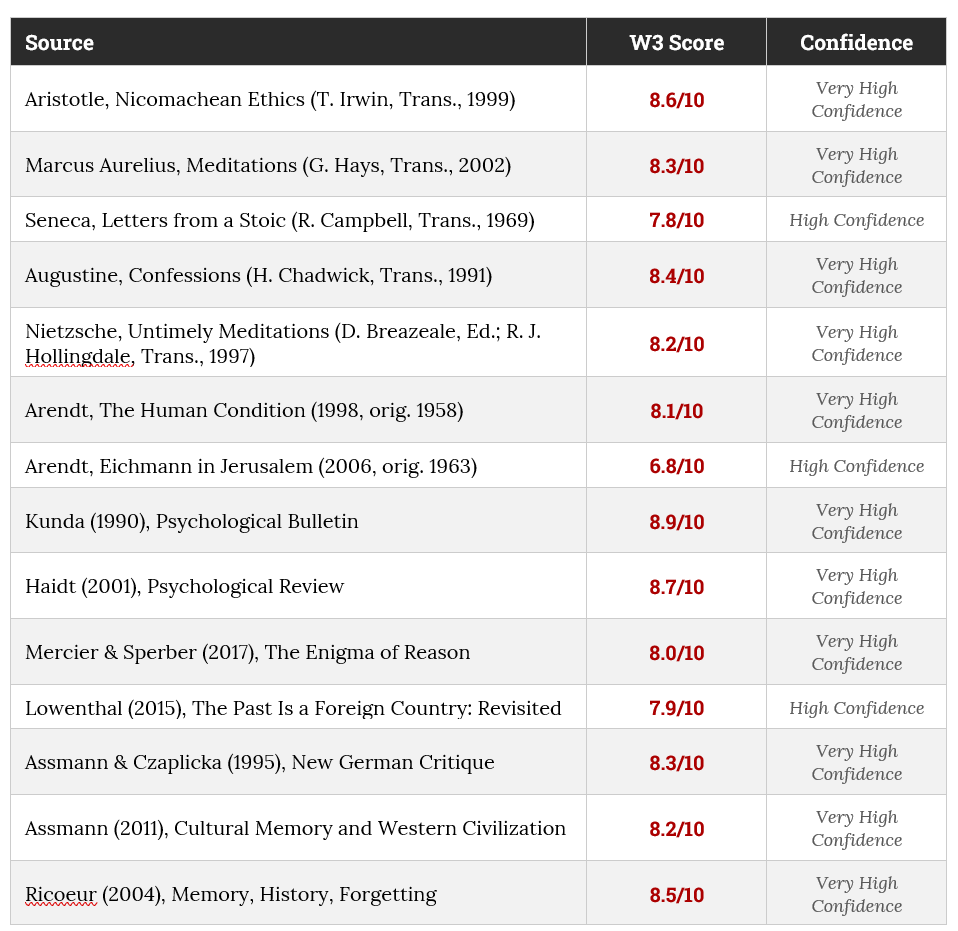
Want the full picture? Members see the complete W3 Evidence Index™ below, including category-level scoring, what each source establishes, what it does not, and the editorial bottom line for every citation.
Already a paid subscriber? See the full W3 Evidence Index Assessment below.
