

The corporate ladder is beginning to look more like a question mark than a career path.
Somewhere between 2020’s mass resignations and 2025’s mass automations, something changed in the way professionals think about work. The decades old promise of stability, climb steadily, stay loyal, retire comfortably, has (no so) quietly eroded. In its place, a new, more fluid kind of ambition is emerging. Not the pursuit of titles or tenure, but the pursuit of purpose.
For professionals in their 30s and 40s, this shift feels less like rebellion and more like a reckoning.
After all, this generation, my generation, has done everything “right.” We went to college. We upskilled. WE learned to pivot. We stayed through reorganizations, mergers, and digital overhauls. And now, after years of navigating uncertainty, we are watching companies restructure entire departments in a single email.
The realization is unsettling: stability is no longer something an employer gives you. It is something you build for yourself.
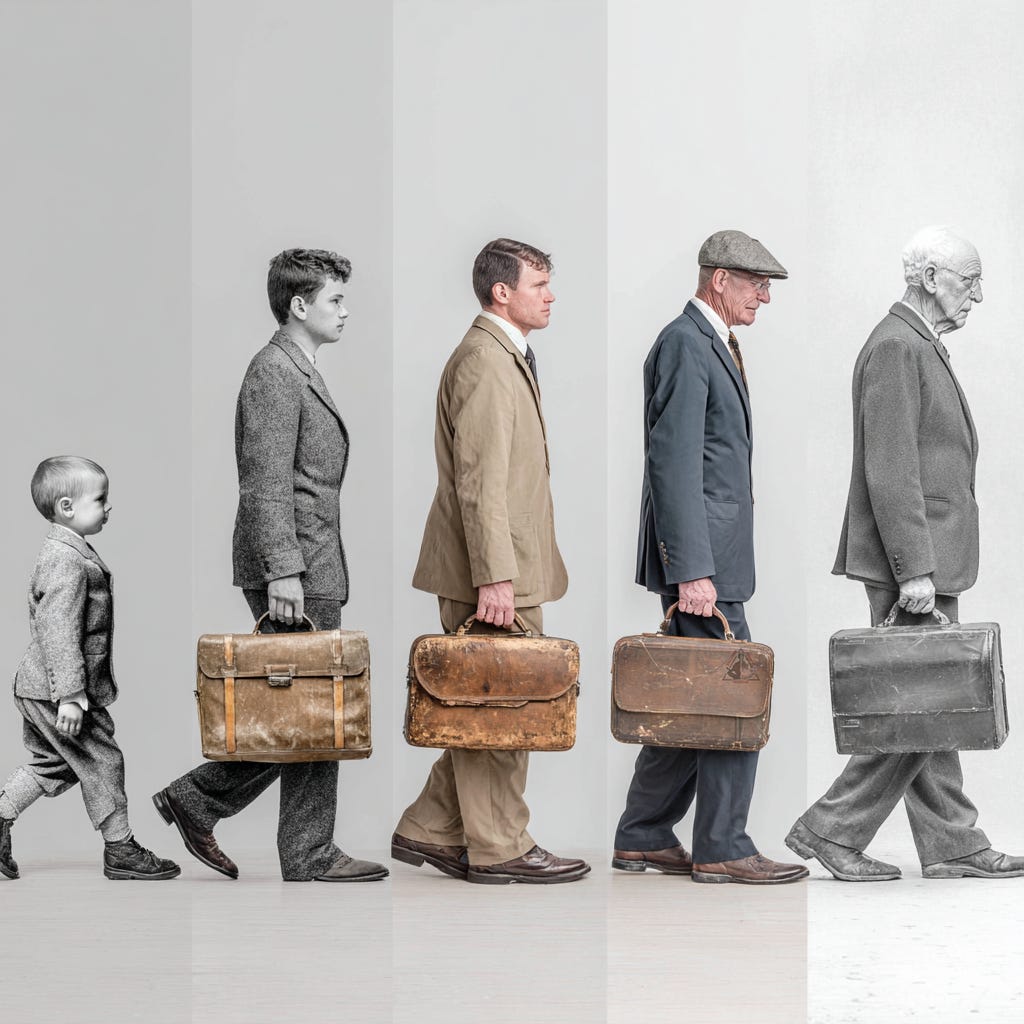
The Rise of the “Portfolio Career”
In conversations with mid-level professionals across industries, from finance to tech to government contracting, one trend keeps surfacing: a quiet migration toward independence.
The “portfolio career” has replaced the traditional ladder for a growing share of workers. Instead of one full-time identity, professionals are curating multiple income streams: consulting roles, creative projects, and teaching positions among them. The shift is not just economic; it is philosophical.
People are no longer asking, “What do I do?” but rather, “What do I build?”
The numbers back up what this trend feels like anecdotally. As of 2026, an estimated 39% of the US workforce does some freelance or independent work, up from roughly 35% the year before, and nearly 73 million Americans now work independently in some capacity, up sharply from about 42 million before the pandemic (Upwork, 2026). Independent work is no longer a side hustle confined to entry-level gig work either: 38% of skilled knowledge workers now operate as freelancers or independent professionals, and current projections suggest the US freelance workforce could surpass half of all workers by 2027 (Upwork, 2026). Beneath those numbers lies something deeper: a cultural reorientation toward autonomy. The pandemic sparked it. AI is accelerating it. But purpose, not fear, is what appears to sustain it.
This is not about rejecting employment. It is about refusing dependency.
A Crisis of Meaning
There is an emotional undercurrent to this shift that numbers alone cannot explain. When people talk about leaving their jobs now, they rarely say they are chasing more money. They say they are chasing meaning. They are chasing a healthy work-life balance.
The Great Resignation did not end; it evolved. What began as burnout has matured into discernment. Professionals are no longer content with “just enough.” They want work that feels aligned with their identity, their ethics, and their impact.
But here is the tension: meaning does not pay the bills, and independence does not come with benefits. The result is a generation straddling two worlds, one foot in traditional employment, the other testing the waters of creative and entrepreneurial freedom.
It is messy. It is uncertain. And for many of the people like myself that are living it, it feels necessary.
Because at the heart of this professional reckoning is a working truth for a growing number of workers: when the economy no longer guarantees security, adaptability becomes the more reliable currency.
The Disappearing Middle
Economists are documenting a real and specific shift, not just in wealth but in which jobs actually exist. McKinsey Global Institute’s research on generative AI and the future of work finds that demand is rising for workers in STEM, healthcare, and other high-skill professions, while demand is falling for office support, production, and customer service roles, with an estimated 12 million occupational shifts likely in the United States by 2030 (McKinsey Global Institute, 2023). Notably, generative AI does not follow the same pattern as earlier waves of automation: it shows what researchers call a reverse skill bias, meaning some of its largest effects fall on higher-educated knowledge workers rather than only manual or low-skill roles.
Those in mid-level roles, project managers, analysts, coordinators, are watching parts of their job descriptions dissolve into algorithms and dashboards. The tasks often remain. The positions do not always survive intact. I’d argue that it even evolves.
This is not the end of the middle class. It is a reclassification of it.
The new middle consists of people who can navigate ambiguity, bridge human and technological systems, and operate across multiple domains. It is a smaller club, but arguably a more resilient one, and those who find a footing there tend to be the ones willing to reinvent what work means rather than the ones clinging to what it used to be.
Redefining Success
What does success look like in a world where “career” no longer follows a straight line or ladder?
Maybe it is not about linear progression at all. Maybe it is about cyclical growth: moments of scaling up, recalibrating, then scaling differently. The people managing this transition well are not necessarily the loudest or most visible. They are the ones who have stopped measuring worth strictly by promotion and started measuring it by something closer to peace of mind.
That said, this reckoning is not free of real anxiety. Pew Research Center found that 21% of US workers now say at least some of their work is done using AI, up from 16% a year earlier, and worker sentiment about this shift remains genuinely mixed: 52% of workers say they are worried about AI’s future impact on their work, and 32% believe it will mean fewer job opportunities for them specifically (Pew Research Center, 2025). Redefining success is easier to write about than to live through, and it is worth naming that tension honestly rather than smoothing over it.
The Takeaway
The professional landscape of the next few years will likely reward people who treat their careers more like ecosystems, diverse, adaptable, and resilient to disruption, than like ladders. The traditional ladder has not entirely disappeared, but for a meaningful and growing share of the workforce, it has been replaced by something closer to a network: a web of skill, connection, and intention that grows stronger with deliberate choices rather than tenure alone.
If the past decade was largely about survival, the next one is likely to be more about design.
Designing your work.
Designing your time.
Designing your meaning.
Stability in the old sense, guaranteed by an employer, is not coming back for most people. But agency, for those able to claim it, is already available.
W3 Insight
The professional reckoning is not really about losing control. For many workers, it is about renegotiating where control comes from. The future increasingly belongs to those who stop waiting for job security in its old form and start building something closer to it on their own terms, with eyes open to both the freedom and the real financial trade-offs that come with it.
W3 Evidence Index™
W3 Evidence Index™ Score: 6.1/10
Confidence Level: Moderate Confidence
Full category breakdown, assessment, and limits available below for paid subscribers.
