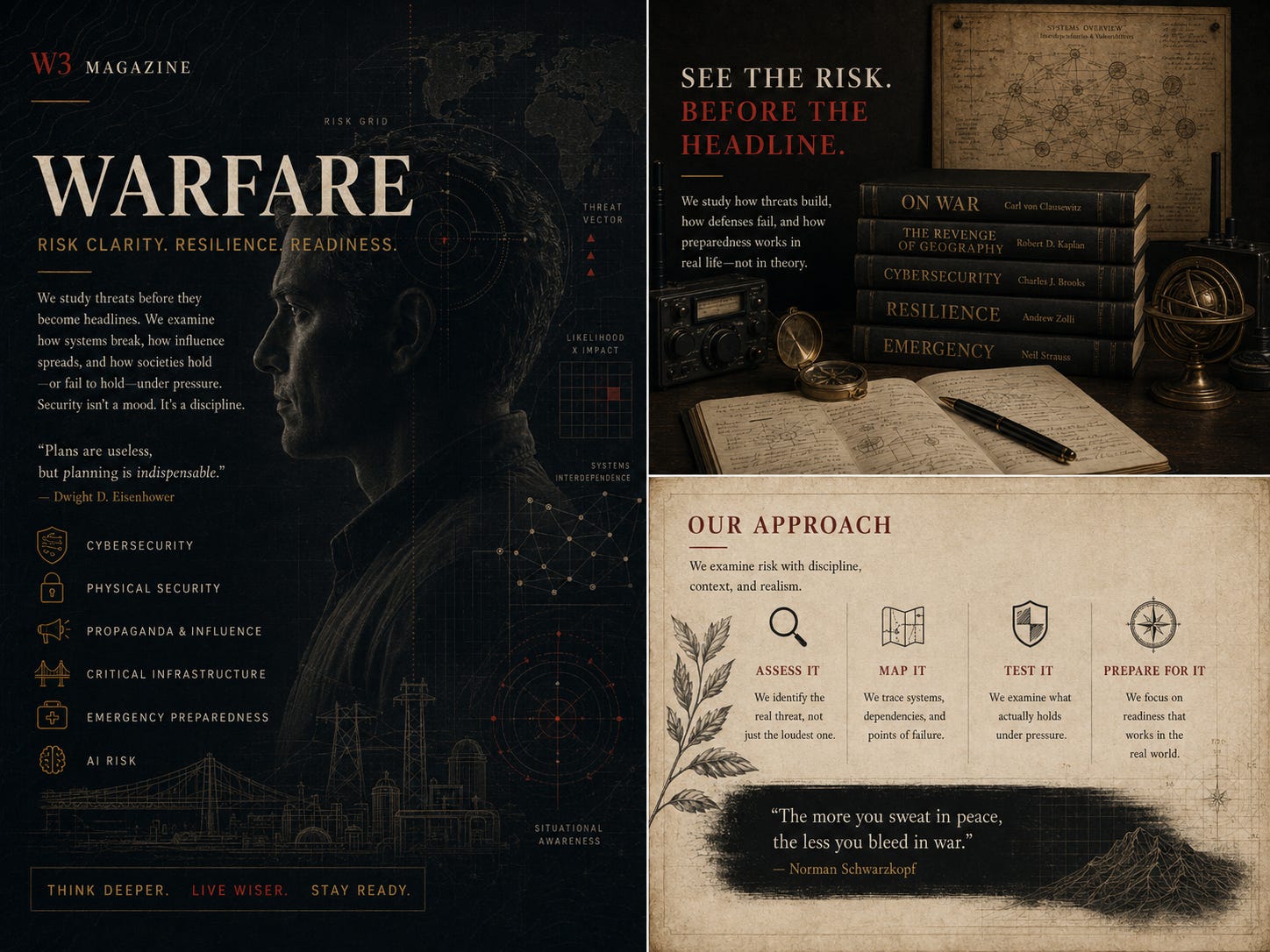
Warfare
Most people only think about security after something has already gone wrong. A breach makes headlines. A disaster catches a region unprepared. A conflict escalates faster than anyone expected, and suddenly everyone has an opinion about a risk they ignored for years. By the time the threat is visible to a casual observer, the people who study it closely have usually been watching it build for a long time.
This section exists for the watching, not just the reacting.
What you’ll find here
Expect writing on cybersecurity, physical security, propaganda, terrorism, critical infrastructure, emergency preparedness, AI risk, and the broader forces that shape conflict and resilience at every scale, from a household deciding how to prepare for a disaster, to a nation deciding how to deter one. This section treats security as a discipline, not a mood. That means real attention to how threats actually work, how defenses actually fail, and how preparedness actually functions when it’s done well instead of performatively.
It also means resisting two opposite temptations. The first is fear for its own sake, the kind of content that treats every risk as imminent catastrophe because alarm gets attention. The second is false comfort, the instinct to wave away real threats because acknowledging them is uncomfortable. Neither serves you. What serves you is an accurate picture of what’s actually dangerous, what’s overstated, and what’s worth doing something about today rather than worrying about indefinitely.
Expect nuance on contested topics here. Security and policy questions rarely have a clean answer that satisfies everyone, and this section won’t manufacture one just to wrap a piece up neatly. Where the evidence is genuinely unsettled, that uncertainty will be named, not hidden.
Why it’s part of W3
Security is rarely just technical. A cyberattack exploits human psychology as much as software, which pulls in Wellness. A nation’s tolerance for risk is shaped by its myths about strength and vulnerability, which is Wisdom showing up in policy. Preparedness, at its core, is a discipline of attention: noticing what most people overlook until it’s too late. That’s the same discipline this entire publication is trying to build, just aimed at the threats most people would rather not think about until they have to.
If you’d rather see the risk coming than read about it afterward, you’re in the right section.

