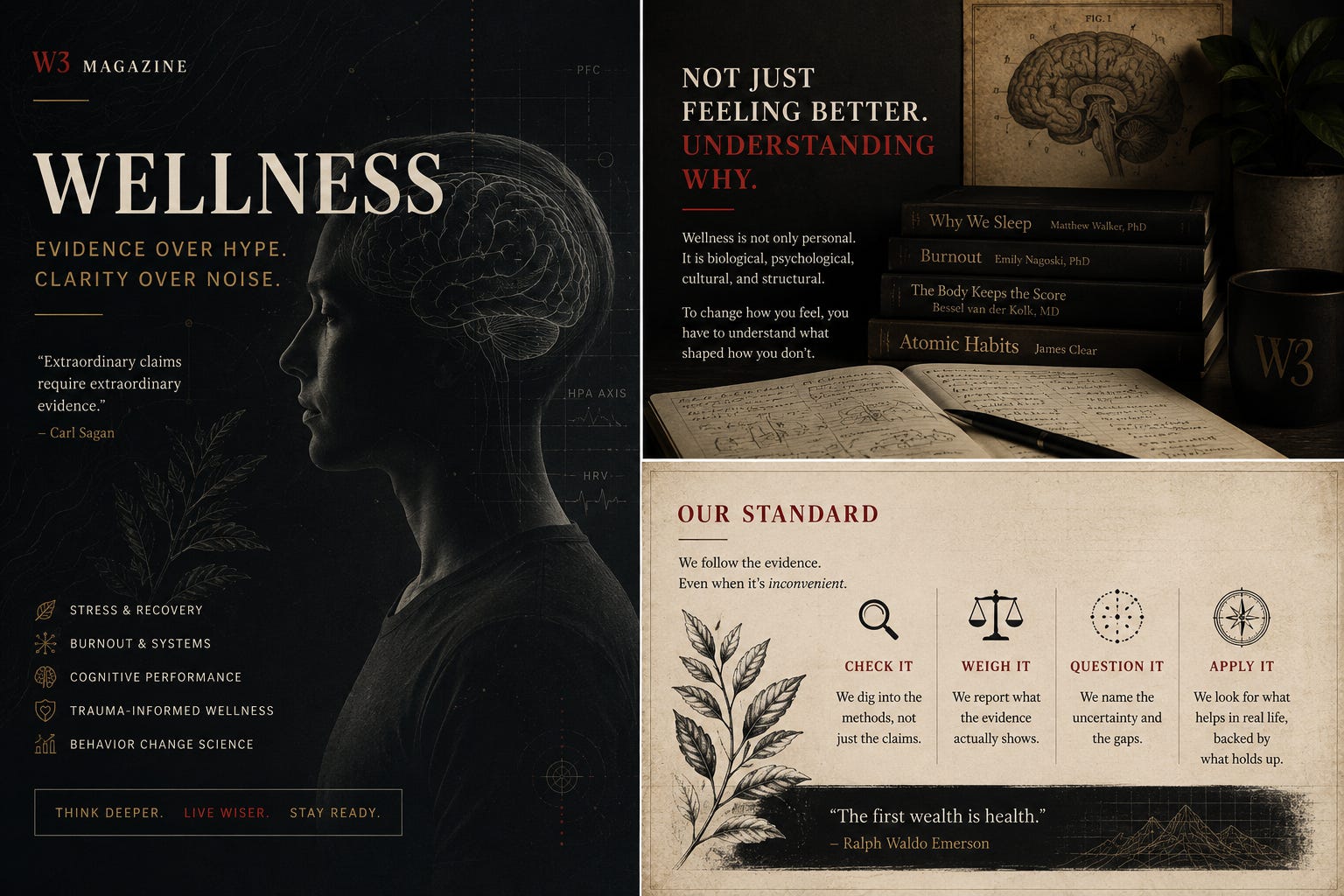
Wellness
Most wellness content asks you to trust it. This section asks you to check it.
That’s not a knock on wanting to feel better, sleep better, or handle stress without falling apart. Those are reasonable things to want. The problem is what’s grown up around that want: an entire industry that has learned to borrow the language of science without doing the work science actually requires. A supplement gets called “clinically proven.” A morning routine gets called “neuroscience backed.” A breathing technique gets credited with effects no study has actually demonstrated. Confidence gets manufactured faster than evidence does, and most readers have no easy way to tell the difference.
This section is where W3 tries to close that gap.
What you’ll find here
Expect writing on stress and recovery, burnout and the conditions that actually cause it, cognitive performance, trauma informed approaches to wellness, and the kind of behavior change research that holds up once you look past the headline. When a claim about the body or mind gets made here, the goal is to show you what the evidence actually supports, what it doesn’t, and where the honest uncertainty still lives.
That means some pieces will disappoint you a little. A trend you liked might not hold up. A claim you’ve repeated to friends might turn out to be thinner than it sounded. That’s the point. Better to know now than to keep building habits on a foundation that was never solid.
It also means this section won’t traffic in the usual wellness culture moves: no shame dressed up as motivation, no urgency manufactured to sell something, no pretending that complex problems like burnout or chronic stress have a single root cause or a single fix. Real recovery is usually slower and less photogenic than the content promising it.
Why it’s part of W3
Wellness rarely exists in isolation. The way you handle stress is shaped by what you believe about control and suffering, which is a Wisdom question. The systems that produce burnout, workplace culture, economic pressure, even the design of the apps on your phone, are systems of power and risk, which edges into Warfare. Keeping Wellness in conversation with the other two lenses is what keeps this section from becoming another self-help feed. It’s not just about feeling better. It’s about understanding why you don’t, clearly enough to do something real about it.
If that’s the kind of wellness writing you’ve been looking for, you’re in the right section.

