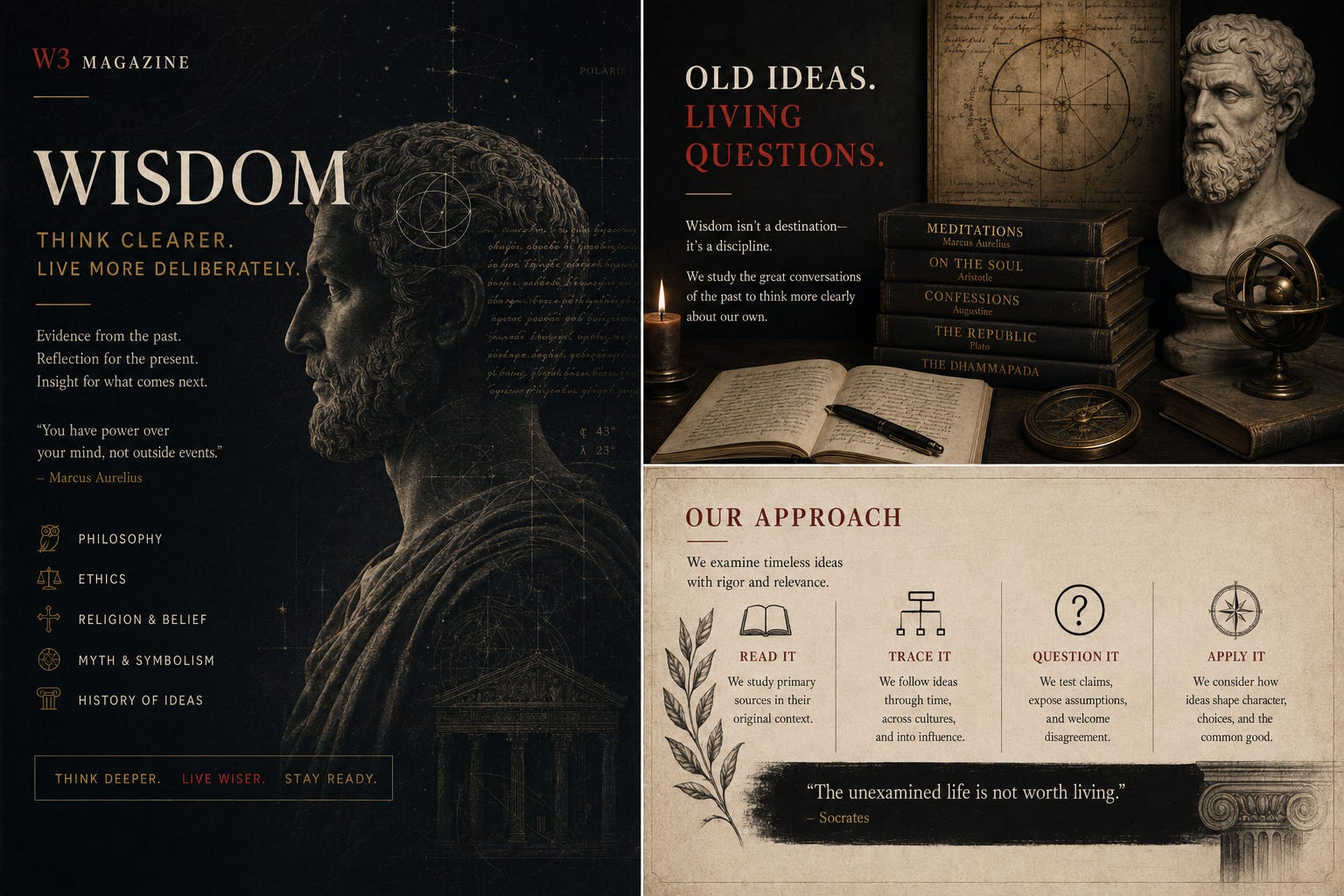
Wisdom
Every generation thinks it’s the first to face real uncertainty. None of them are. Long before algorithms and news cycles, people were asking how to live well, how to bear what can’t be controlled, and how to tell a good decision from a comfortable one. Those questions didn’t get answered once and settled. They got argued, refined, and argued again, across centuries, by people working with the same basic problem we still have: how to think clearly when the stakes are real.
This section is where W3 goes looking for that argument.
What you’ll find here
Expect writing on philosophy, ethics, religion, myth, and the history of ideas, treated as living material rather than museum pieces. Stoicism shows up here, not as a productivity hack, but as a serious framework for separating what you control from what you don’t. Religious and mythic traditions show up as evidence of how people have always tried to make sense of suffering, meaning, and belonging, not as artifacts to be debunked or defended on command. The history of an idea matters here, because most of the ideas we treat as new turn out to have a lineage worth understanding.
This section won’t flatten difficult thinkers into quote graphics. Marcus Aurelius gets contradicted by his own contemporaries. Religious traditions disagree with themselves across centuries. The goal isn’t a tidy life lesson at the end of every piece. It’s a clearer picture of how people who took these questions seriously actually reasoned through them, including where they got it wrong.
Expect some discomfort here too. Wisdom traditions don’t always agree with each other, or with modern intuitions, and this section won’t pretend otherwise just to keep things comfortable. Treating ideas seriously means following them somewhere, not stopping the moment they get inconvenient.
Why it’s part of W3
Wisdom is the lens that explains why the other two exist. The way you respond to a health scare, a security threat, or a moment of real uncertainty depends on a framework you probably never chose consciously. Stoic philosophy and modern threat assessment are doing the same exercise: separate what’s controllable, act on that, let the rest go. A culture’s myths shape what it considers an acceptable risk, which bleeds straight into Warfare. None of these lenses sit still on their own. Wisdom is usually the one underneath the other two, quietly doing the work.
If you’ve ever wanted permission to take old ideas seriously again, this is that permission.

